


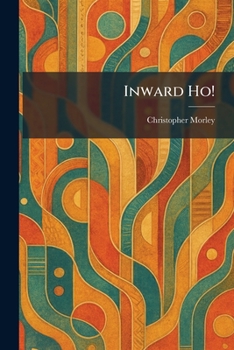
Inward Ho!

"Inward Ho " is a profound collection of philosophical essays by the celebrated American man of letters, Christopher Morley. In this work, Morley pivots from his usual whimsical fiction to offer a series of meditative explorations into the human spirit and the literary consciousness. Written with his characteristic wit and stylistic grace, the volume delves into the inner life of the writer and the reader, examining the elusive nature of thought and the quiet power of literature.
Throughout these brief but evocative pieces, Morley ponders the relationship between the external world and the internal landscape of the mind. He discusses the craft of writing not just as a professional endeavor, but as a spiritual and intellectual necessity. "Inward Ho " serves as a testament to the value of introspection in an increasingly fast-paced world, encouraging readers to turn their gaze inward to find meaning and solace. This collection remains a significant contribution to 20th-century American belles-lettres, offering timeless insights into the joys of reading, the weight of words, and the perpetual search for creative truth. It is an essential read for those who appreciate literary reflection and the art of the essay.
This work has been selected by scholars as being culturally important, and is part of the knowledge base of civilization as we know it. This work was reproduced from the original artifact, and remains as true to the original work as possible. Therefore, you may see the original copyright references, library stamps (as most of these works have been housed in our most important libraries around the world), and other notations in the work.
This work is in the public domain in the United States of America, and possibly other nations. Within the United States, you may freely copy and distribute this work, as no entity (individual or corporate) has a copyright on the body of the work.
As a reproduction of a historical artifact, this work may contain missing or blurred pages, poor pictures, errant marks, etc. Scholars believe, and we concur, that this work is important enough to be preserved, reproduced, and made generally available to the public. We appreciate your support of the preservation process, and thank you for being an important part of keeping this knowledge alive and relevant.
Customer Reviews
ThriftBooks ® and the ThriftBooks ® logo are registered trademarks of Thrift Books Global, LLC
