


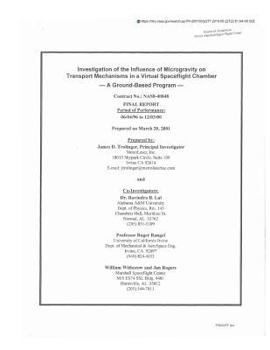
Investigation of the Influence of Microgravity on Transport Mechanisms in a Virtual Spaceflight Chamber: A Ground-Based Program
No Customer Reviews

The IML-1 Spaceflight produced over 1000 holograms of a well-defined particle field in the low g Spacelab environment; each containing as much as 1000 megabytes of information. This project took advantage of these data and the concept of holographic "virtual" spaceflight to advance the understanding of convection in the space shuttle environment, g-jitter effects on crystal growth, and complex transport phenomena in low Reynolds number flows. The first objective of the proposed work was to advance the understanding of microgravity effects on crystal growth. This objective was achieved through the use of existing holographic data recorded during the IML-1 Spaceflight. The second objective was to design a spaceflight experiment that exploits the "virtual space chamber concept" in which holograms of space chambers can provide a virtual access to space. This led to a flight definition project, which is now underway under a separate contract known as SHIVA, Spaceflight Holography Investigation in a Virtual Apparatus.Trolinger, James D. and Lal, Ravindra B. and Rangel, Roger and Witherow, William and Rogers, JanMarshall Space Flight CenterMICROGRAVITY; TRANSPORT PROPERTIES; VIRTUAL REALITY; COMPUTERIZED SIMULATION; ENVIRONMENT SIMULATION; FLIGHT SIMULATION; SPACE FLIGHT; AEROSPACE ENVIRONMENTS; SPACEBORNE EXPERIMENTS; CRYSTAL GROWTH; HOLOGRAPHY
Format:Paperback
Language:English
ISBN:1723853860
ISBN13:9781723853869
Release Date:January 1
Publisher:Independently Published
Length:70 Pages
Weight:0.41 lbs.
Dimensions:0.1" x 8.5" x 11.0"
Customer Reviews
0 rating
Copyright © 2025 Thriftbooks.com
Terms of Use | Privacy Policy | Do Not Sell/Share My Personal Information | Cookie Policy | Cookie Preferences | Accessibility Statement
ThriftBooks ® and the ThriftBooks ® logo are registered trademarks of Thrift Books Global, LLC
ThriftBooks ® and the ThriftBooks ® logo are registered trademarks of Thrift Books Global, LLC
