


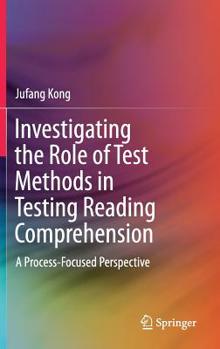
Investigating the Role of Test Methods in Testing Reading Comprehension: A Process-Focused Perspective
No Customer Reviews

Select Format
Select Condition 
Book Overview
Part OneChapter One Introduction1.1 Research Background1.2 Research Focus1.3 Book Structure1.4 SummaryChapter Two Theories of Reading Comprehension2.1 Nature of Reading Comprehension2.1.1 Psycholinguistic Perspective of Reading Comprehension2.1.2 Cognitive Perspective of Reading Comprehension2.1.3 Processing Patterns of Reading Comprehension2.1.3.1 Bottom-up Processing2.1.3.2 Top-down Processing2.1.3.3 Interactive Processing2.2 Factors Involved in Reading Comprehension2.2.1 Reader2.2.2 Text2.2.3 Interaction2.2.3.1 Purpose of Reading Comprehension2.2.3.2 Skills2.2.3.3 Strategies and Metacognitive Strategies2.3 Khalifa and Weir' Model of Reading Comprehension2.4 SummaryChapter Three Construct and Validity3.1 Construct3.1.1 A Trait Theorist View3.1.2 A Behaviourist View3.1.3 An Interactionalist View3.2 Validity3.3 Validation3.3.1 Messick's Validation Framework3.3.2 Kane's Interpretive Argument Framework3.3.3 Bachman and Palmer's AUA Framework3.3.4 Campbell and Fiske's MTMM Approach 3.4 A Process-focused Construct Validation Framework3.5 SummaryChapter Four Test Method and Response Format4.1 Test Method4.2 Response Format4.2.1 Response Formats Most Commonly Used in Reading Comprehension Tests4.2.1.1 MCQ Format4.2.1.2 SAQ Format4.2.2 Response Format Effect(s) on Test takers' Reading Comprehension Per-formances4.3 SummaryChapter Five Methodology5.1 Quantitative Approach5.2 Qualitative Approach5.3 Mixed Methods Approach5.4 A Qualitative Dominant Mixed Methods Approach5.5 Summary
Part TwoChapter Six Quantitative Strand6.1 Research Design6.1.1 Research Procedures6.1.2 Participants6.1.3 Research Instruments6.2 Findings6.2.1 Descriptive Statistics6.2.1.1 Item Statistics6.2.1.2 Passage Statistics6.2.1.3 Total Score Statistics6.2.2 Inferential Statistics6.2.2.1 Paired-sample T-test6.2.2.2 MTMM CFA6.2.3 Summary of Findings 6.3 SummaryChapter Seven Employing Think Aloud Protocols (TAPs) to Explore Test takers' Cognitive Processes7.1 TAPs Paradigm7.1.1 Rationale and Concerns of TAPs7.1.2 TAPs in Reading Research7.1.3 TAPs in Language Testing and Assessment7.2 Research Design7.2.1 Research Procedures7.2.1.1 Pilot Study7.2.1.2 Formal Data Collection7.2.1.3 TAPs Data Transcription and Coding7.2.1.4 Cognitive Process Route Map7.3 Findings7.3.1 Test Level Analysis7.3.2 Question Type Level Analysis7.3.2.1 Question Type 1 TAPs Data Analysis7.3.2.2 Question Type 2 TAPs Data Analysis7.3.2.3 Question Type 3 TAPs Data Analysis7.3.2.4 Question Type 4 TAPs Data Analysis7.3.2.5 Question Type 5 TAPs Data Analysis7.4 Summary of Findings7.5 SummaryChapter Eight Employing Eye Tracking to Explore Test takers' Cognitive Processes8.1 ET Paradigm8.1.1 Rationale and Concerns of ET8.1.2 ET in Reading Research8.1.3 ET in Language Testing and Assessment8.2 Research Design8.2.1 Research Procedures8.2.1.1 Research Instruments8.2.1.2 Pilot Study8.2.1.3 Participants8.2.1.4 Formal Data Collection8.3 Findings8.3.
Part TwoChapter Six Quantitative Strand6.1 Research Design6.1.1 Research Procedures6.1.2 Participants6.1.3 Research Instruments6.2 Findings6.2.1 Descriptive Statistics6.2.1.1 Item Statistics6.2.1.2 Passage Statistics6.2.1.3 Total Score Statistics6.2.2 Inferential Statistics6.2.2.1 Paired-sample T-test6.2.2.2 MTMM CFA6.2.3 Summary of Findings 6.3 SummaryChapter Seven Employing Think Aloud Protocols (TAPs) to Explore Test takers' Cognitive Processes7.1 TAPs Paradigm7.1.1 Rationale and Concerns of TAPs7.1.2 TAPs in Reading Research7.1.3 TAPs in Language Testing and Assessment7.2 Research Design7.2.1 Research Procedures7.2.1.1 Pilot Study7.2.1.2 Formal Data Collection7.2.1.3 TAPs Data Transcription and Coding7.2.1.4 Cognitive Process Route Map7.3 Findings7.3.1 Test Level Analysis7.3.2 Question Type Level Analysis7.3.2.1 Question Type 1 TAPs Data Analysis7.3.2.2 Question Type 2 TAPs Data Analysis7.3.2.3 Question Type 3 TAPs Data Analysis7.3.2.4 Question Type 4 TAPs Data Analysis7.3.2.5 Question Type 5 TAPs Data Analysis7.4 Summary of Findings7.5 SummaryChapter Eight Employing Eye Tracking to Explore Test takers' Cognitive Processes8.1 ET Paradigm8.1.1 Rationale and Concerns of ET8.1.2 ET in Reading Research8.1.3 ET in Language Testing and Assessment8.2 Research Design8.2.1 Research Procedures8.2.1.1 Research Instruments8.2.1.2 Pilot Study8.2.1.3 Participants8.2.1.4 Formal Data Collection8.3 Findings8.3.
Format:Hardcover
Language:English
ISBN:9811370206
ISBN13:9789811370205
Release Date:April 2019
Publisher:Springer
Length:212 Pages
Weight:1.10 lbs.
Dimensions:0.6" x 6.1" x 9.2"
Customer Reviews
0 rating
Copyright © 2025 Thriftbooks.com
Terms of Use | Privacy Policy | Do Not Sell/Share My Personal Information | Cookie Policy | Cookie Preferences | Accessibility Statement
ThriftBooks ® and the ThriftBooks ® logo are registered trademarks of Thrift Books Global, LLC
ThriftBooks ® and the ThriftBooks ® logo are registered trademarks of Thrift Books Global, LLC
