


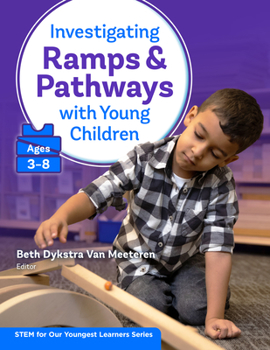
Investigating Ramps and Pathways with Young Children (Ages 3-8)

Select Format
Select Condition 
Book Overview
Children are intrigued by moving objects, even more so when they can engineer the movement. This volume in the STEM for Our Youngest Learners Series uses Ramps and Pathways as a context to provide children ages 3-8 with opportunities to engage in STEM every day. Ramps and Pathways is a meaningful and fun way for children to develop engineering habits of mind as they explore concepts in force and motion, properties of objects, and how an object's properties affect its movement. In the process, children develop spatial thinking that is essential for future careers in STEM. The text also offers guidance for arranging the physical, intellectual, social-emotional, and promotional environments of a classroom to embrace the natural integration of literacy learning. Each volume in this series includes guidance for forming partnerships with families and administrators that support STEM learning, vignettes showing educators and children engaging in inquiry learning, tips for selecting materials, modifications and accommodations for diverse learners, ways to establish adult learning communities that support professional development, and more.
Book Features:
Alignment with both the Head Start Early Learning Outcomes Framework (ELOF) and the NGSS Science and Engineering Practices, with specific descriptions of how those science and engineering practices in Ramps and Pathways look and feel in Pre-K-2 classrooms.Examples of how to integrate literacy learning in a meaningful way.Descriptions of how the open-ended nature of ramps and pathways aligns with the Universal Design for Learning Framework (UDL). Guidance to help teachers anticipate and plan for all children to become purposeful, motivated, resourceful, knowledgeable, strategic, and goal-directed about learning.Examples of how to stage, introduce, and support children's designs to develop engineering habits of mind (systems thinking, optimism, creativity, communication, collaboration, attention to ethical considerations).A meaningful and healthy context to grow children's executive function skills (EFs), including inhibitory control, working memory, and cognitive flexibility.Customer Reviews
ThriftBooks ® and the ThriftBooks ® logo are registered trademarks of Thrift Books Global, LLC
