


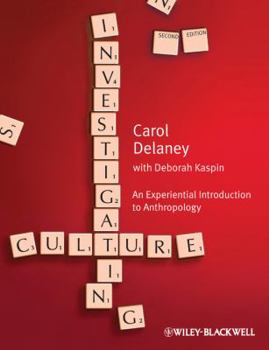
Investigating Culture: An Experiential Introduction to Anthropology


Select Format
Select Condition 
Book Overview
In its new Second Edition, the innovative and ever-popular Investigating Culture has been updated and revised to incorporate new teacher and student feedback. Carol Delaney and Deborah Kaspin provide an expanded introduction to cultural anthropology that is even more accessible to students. Revised and enhanced new edition that incorporates additional material and classroom feedback Accessible to a wider range of students and educational settings Provides a refreshing alternative to traditional textbooks by challenging students to think in new ways and to apply ideas of culture to their own lives Focuses on the ways that humans orient themselves, e.g., in space and time, according to language, food, the body, and the symbols provided by public myth and ritual Includes chapters that frame the central issues and provide examples from a range of cultures, with selected readings, additional suggested readings, and student exercises
Format:Paperback
Language:English
ISBN:1405154241
ISBN13:9781405154246
Release Date:February 2011
Publisher:Wiley-Blackwell
Length:424 Pages
Weight:2.03 lbs.
Dimensions:9.7" x 1.1" x 7.4"
Customer Reviews
1 rating
A Very Original (But Just Good) Introduction to Cultural Anthropology
Published by Thriftbooks.com User , 19 years ago
As a teacher, I used this book during a semester course for college students who admitted to have no idea what anthropology was, and the results were, overall, very positive. They found it interesting and pleasant, and they read and summarized all nine chapters, totaling over 400 pages. Its forte is that, rather than adopting the formalistic approach of conventional textbooks, it engages students, capturing their attention at the experiential level. With simple language, it provides a straightforward introduction to what is to do ethnographic fieldwork and to think anthropologically, leading students to learn, not only about "other cultures", but also, and mainly, to reflect upon their own ethnocentrism. However, due to such an experiential focus, the book misses important anthropological concerns with macro-analysis, structuralism and history; it also misses a minimally systematic discussion of classical topics, such as religion or economy. And, some of my female students found that the author's recurrent discussion on gender exploitation was excessive and even tiresome. Finally, though it is understandable that geographic expertise may limit one's ability to discuss other world cultures, I expected a wider and better variety of examples, beyond rural Turkey, patriarchy and the author's (and close colleagues') own excerpts. I was stunned with crass mistakes, such as claiming that Brazilians love tango (rather than samba), to name just one among several blunders. Having said that, I still maintain that this book yields good results among undergraduate students. I'm not sure I'd employ it in privileged institutions such as U. Chicago or Ivy League, but certainly so in more modest colleges. In any case, the book is quite original, providing an innovative approach to learn the discipline. The supplementary articles at the end of each chapter are a very good idea. I hope that the author fixes, calibrates and improves this interesting book in future editions.
Copyright © 2026 Thriftbooks.com
Terms of Use | Privacy Policy | Do Not Sell/Share My Personal Information | Cookie Notice | Cookie Preferences | Accessibility Statement
ThriftBooks ® and the ThriftBooks ® logo are registered trademarks of Thrift Books Global, LLC
ThriftBooks ® and the ThriftBooks ® logo are registered trademarks of Thrift Books Global, LLC
