


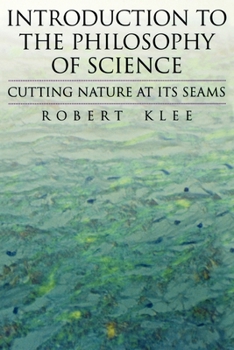
Introduction to the Philosophy of Science

Select Format
Select Condition 
Book Overview
Introduction to the Philosophy of Science: Cutting Nature at Its Seams is a clear and lively explanation of key concepts and issues in the philosophy of science. It surveys the field from positivism to social constructivism, focusing on the metaphysical implications of science as a form of knowledge gathering that explains what the world is really like, while simultaneously arguing for the superiority of a holistic model of scientific theories over competing models. An innovative feature is the use of immunology as the central domain of illustration, in contrast to other philosophy of science texts that draw examples predominantly from physics. The text also presents Thomas Kuhn's model of science clearly and accurately, rectifying the notorious and widespread misinterpretations projected upon it in the past. Klee discusses both traditional models of science and alternative interpretations, most notably nonfeminist and feminist models inspired by the work of Kuhn. Richly illustrated and complete with a glossary of over eighty key terms, this book serves as an ideal text for undergraduates, because it presents a highly accessible and contemporary investigation of science as a form of inquiry capable of revealing to us the structure of the world.
Format:Paperback
Language:English
ISBN:0195106113
ISBN13:9780195106114
Release Date:December 1996
Publisher:Oxford University Press
Length:272 Pages
Weight:0.90 lbs.
Dimensions:0.5" x 6.1" x 9.2"
Customer Reviews
4 ratings
book review
Published by Thriftbooks.com User , 17 years ago
The book was in great condition, better than I had expected and the price was excellent.
an excellent and objective overview
Published by Thriftbooks.com User , 27 years ago
I highly recommend this book to anyone wishing to get up to speed on what has happened in the philosophy of science during the past three centuries. The author speaks in his own voice, which keeps the book interesting and engaging from start to finish. This is not a dry textbook. At the same time, the author clearly identifies where his own sympathies lie, and is very objective in his treatment of opposing views.A couple of areas for improvement: The author mentions Kant's idea of noumena and phenomena on a few occasions in the book, but does not really discuss the Kantian idea of the "external world" any further. I wish he did. Also, the author seems to imply that we shouldn't be too hasty to let our philosophies be influenced by the results we find in quantum physics (presumably because they tend to be so bizarre and atypical). I would have liked the author to elaborate a bit more on this view. I think many people interested in the philosophy of science would argue the opposite: A good philosophy of science must necessarily accommodate the most perplexing and paradoxical scientific findings. In summary, the book is definitely worthwhile, and I hope many scientists and non-scientists read it.
A clear introduction to the Philosophy of Science
Published by Thriftbooks.com User , 27 years ago
Robert Klee's introductory text to the Philosophy of Science is a concise and well-written introduction to the Philosophy of Science. It gives a great framework (and suggested further readings) for the person interested in this topic. The contributions of Hempel, Popper, Quine, Kuhn, et al are presented in a thought provoking manner.If you enjoy philosophy and have not ventured into the philosophy of science, this is a great place to begin.
An exceedingly useful book that frames the issues well.
Published by Thriftbooks.com User , 28 years ago
For newcomers and old hands engaged in the philosophy of science, Klee's book serves to frame the subject in a clear and coherent way. Klee uses immunology as his jumping-off point, rather than physics in order to frame the general areas of inquiry and disputes within the subject. This works quite well, even for those of us uninitiated in any serious way into esoteric immunological studies and its attendant lexicon. Klee touches on all the basics and revists elementary concepts in logic and philosophy that will be useful for the non-philosopher and general reader. There is a lucid discussion of the debates and disputes within the subject, such as between Kuhn and Popper, and Klee pays ample attention to other of the major figures, particularly those weighing in the realism/antirealism debate. Further,Introduction to Philosophy of Science will serve as one of those rare texts that can be called upon to fill in knowledge gaps and memory lapses in other areas in philosophy generally. While the subject matter can be arid and difficult to wade through, Klee's book is brilliantly written and fun to read. He makes no bones about his own realism, but is reasonably fair to anti-realist critics. Yet at times his loss of patience with those who take an anti-realist position bleeds through his prose, often in quite humorous ways. This books will be read and re-read by serious students of the subject and may become a standard text in the philosophy of science used in undergraduate and graduate pedagogy, as well it should.
Copyright © 2026 Thriftbooks.com
Terms of Use | Privacy Policy | Do Not Sell/Share My Personal Information | Cookie Notice | Cookie Preferences | Accessibility Statement
ThriftBooks ® and the ThriftBooks ® logo are registered trademarks of Thrift Books Global, LLC
ThriftBooks ® and the ThriftBooks ® logo are registered trademarks of Thrift Books Global, LLC
