


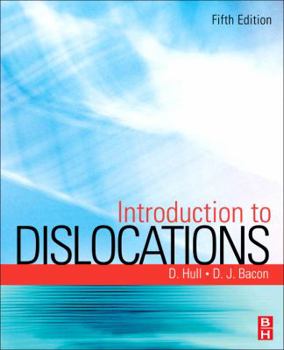
Introduction to Dislocations


Select Format
Select Condition 
Book Overview
In materials science, dislocations are irregularities within the crystal structure or atomic scale of engineering materials, such as metals, semi-conductors, polymers, and composites. Discussing this specific aspect of materials science and engineering, Introduction to Dislocations is a key resource for students. The book provides students and practitioners with the fundamental principles required to understand dislocations. Comprised of 10 chapters, the text includes advanced computer modeling and very high-resolution electron microscopy to help readers better understand the structure of atoms close to the core of dislocations. It shows that atomic arrangement has a significant effect on the formation of dislocations and thereby on the properties of solids. The first two chapters of the book present an overview of dislocations. The crystal structures and the various defects and dislocations are discussed, and methods of observation and diagnosis of dislocations are covered. Chapters 3 to 5 discuss the behavior of dislocations and explain how changes in the structure and arrangement of atoms can affect the behavior of dislocations. The three chapters also discuss the mechanical properties of dislocations. The remaining chapters offer a detailed discussion of the mechanisms of dislocations and the mechanical strength of crystalline solids. The book is written for undergraduate- and graduate-level students in both materials science and mechanical engineering. Non-experts and novices working on mechanical properties, mechanisms of deformation and fracture, and properties of materials, as well as industrial and academic researchers, will find this book invaluable.
Format:Paperback
Language:English
ISBN:0080966721
ISBN13:9780080966724
Release Date:April 2011
Publisher:Butterworth-Heinemann
Length:257 Pages
Weight:0.70 lbs.
Dimensions:0.7" x 7.4" x 9.1"
Customer Reviews
2 ratings
Clear, concise, and well-written
Published by Thriftbooks.com User , 18 years ago
This is an excellent introductory text on dislocation theory. The author does a good job of outlining fundamental materials principles before jumping into defects. The diagrams and images used are top-notch -- if only one could capture such good examples in practice! The latter half of the text covers some information on other types of defects (tilt boundaries, stacking faults) as well as numerous characterization techniques. Recommended!
Very good elementary representations of dislocation theory.
Published by Thriftbooks.com User , 27 years ago
Much better and easier to understand than the many other classical dislocation theory books. It is also very comprehensive, although a little outdated due to its publication date.
Copyright © 2026 Thriftbooks.com
Terms of Use | Privacy Policy | Do Not Sell/Share My Personal Information | Cookie Notice | Cookie Preferences | Accessibility Statement
ThriftBooks ® and the ThriftBooks ® logo are registered trademarks of Thrift Books Global, LLC
ThriftBooks ® and the ThriftBooks ® logo are registered trademarks of Thrift Books Global, LLC
