


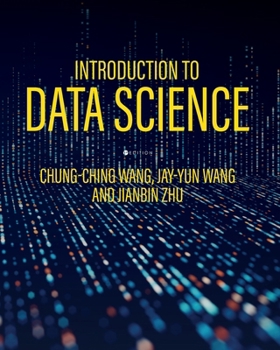
Introduction to Data Science

Introduction to Data Science provides students with a greater understanding of how to extract insights and knowledge from large volumes of data, be it structured or unstructured, and to utilize this data in predictive analytics and decision-making processes. The book covers foundational components of data science, including data collection, cleaning, exploratory analysis, modeling, and interpretation with an emphasis on communication of conclusions to stakeholders.
The book explores various machine learning paradigms, including supervised, unsupervised, and reinforcement learning, detailed through key concepts like classification, regression, clustering, and neural networks. It underscores the necessity for understanding underlying theoretical principles, such as probability, decision theory, and optimization. Furthermore, performance assessment principles for both numerical and categorical target modeling are thoroughly discussed alongside Python code implementations of different algorithms.
Introduction to Data Science is ideal for courses on data science, statistics, and machine learning. The inclusion of practical Python applications makes the book a great fit for programs that emphasize hands-on, practical learning.
Customer Reviews
ThriftBooks® and the ThriftBooks® logo are registered trademarks of Thrift Books Global, LLC
