


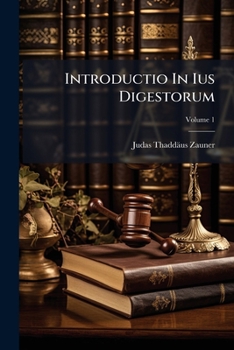
Introductio In Ius Digestorum; Volume 1

Introductio In Ius Digestorum, Volume 1 by Judas Thadd us Zauner is a comprehensive introduction to the Digest, a pivotal component of Roman law codified under Emperor Justinian I. This volume offers readers an in-depth exploration of the Digest's historical context, its structure, and its significance in the broader framework of Roman jurisprudence. Zauner meticulously examines the key principles and concepts underpinning the Digest, providing a foundational understanding for students and scholars of legal history.
This work serves as an invaluable resource for those seeking to understand the roots of modern legal systems and the enduring influence of Roman legal thought. Zauner's insightful analysis illuminates the complexities of the Digest, making it accessible to both novice learners and seasoned legal professionals. The book's enduring value lies in its ability to bridge the gap between ancient legal traditions and contemporary legal scholarship, offering a vital perspective on the evolution of law.
This work has been selected by scholars as being culturally important, and is part of the knowledge base of civilization as we know it. This work was reproduced from the original artifact, and remains as true to the original work as possible. Therefore, you will see the original copyright references, library stamps (as most of these works have been housed in our most important libraries around the world), and other notations in the work.
This work is in the public domain in the United States of America, and possibly other nations. Within the United States, you may freely copy and distribute this work, as no entity (individual or corporate) has a copyright on the body of the work.
As a reproduction of a historical artifact, this work may contain missing or blurred pages, poor pictures, errant marks, etc. Scholars believe, and we concur, that this work is important enough to be preserved, reproduced, and made generally available to the public. We appreciate your support of the preservation process, and thank you for being an important part of keeping this knowledge alive and relevant.
Customer Reviews
ThriftBooks® and the ThriftBooks® logo are registered trademarks of Thrift Books Global, LLC
