


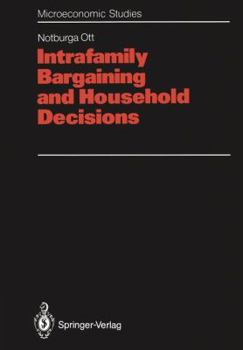
Intrafamily Bargaining and Household Decisions
No Customer Reviews

A model of household decisions based on a bargaining approach is developed providing a comprehensive framework for the analysis of family behavior. Treating the family as an economic organization, household behavior is explained by the cooperation of utility maximizing individuals. The difference to traditional microeconomic household models is that theassumption of a joint household utility function is abandoned. Instead of this, a game theoretic approach is used to model family decisions as a result of intrafamily bargaining. Considering the development of the spouses human capital in a dynamic approach, the long-term effects of intrafamily specialization in market work and work at home are analyzed. Onemajor finding is that in a dynamic setting non-Pareto efficient allocations may result. Empirical tests demonstrate the relevanace of the bargaining approach.
Format:Paperback
Language:English
ISBN:364245710X
ISBN13:9783642457104
Release Date:February 2012
Publisher:Springer
Length:242 Pages
Weight:0.90 lbs.
Dimensions:0.5" x 6.7" x 9.6"
Customer Reviews
0 rating
Copyright © 2026 Thriftbooks.com
Terms of Use | Privacy Policy | Do Not Sell/Share My Personal Information | Cookie Policy | Cookie Preferences | Accessibility Statement
ThriftBooks ® and the ThriftBooks ® logo are registered trademarks of Thrift Books Global, LLC
ThriftBooks ® and the ThriftBooks ® logo are registered trademarks of Thrift Books Global, LLC
