


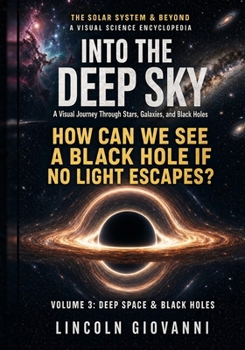
Into the Deep Sky: A Visual Journey Through Stars, Galaxies, and Black Holes

How are stars born-and what happens when the largest stars collapse into black holes?
Into the Deep Sky takes young readers beyond the solar system and into the immense universe of glowing stars, swirling galaxies, mysterious dark matter, and gravity so powerful that even light cannot escape.
Children will explore stellar nurseries, nuclear fusion, red giants, supernovae, white dwarfs, neutron stars, and pulsars. They will journey across the Milky Way, compare different kinds of galaxies, discover how telescopes study invisible wavelengths, and learn how light-years help scientists measure the enormous distances between cosmic objects.
Carefully explained sections introduce black holes, event horizons, accretion disks, gravitational lensing, quasars, gravitational waves, Sagittarius A*, and the first images produced by the Event Horizon Telescope.
Created for curious readers ages 5-8, this visual science encyclopedia presents deep-space concepts through evidence, observation, memorable comparisons, and breathtaking imagery.
Look beyond the planets, follow the light of distant stars, and discover a universe more extraordinary than imagination.
STEM Learning ExperienceInto the Deep Sky supports early STEM learning by helping children:
Understand that a light-year measures distance.Connect distance with light-travel time and looking into the cosmic past.Explore visible, infrared, radio, ultraviolet, X-ray, and gamma-ray astronomy.Follow mass-dependent stellar life cycles from star formation to stellar remnants.Compare stars, star clusters, galaxies, and galaxy clusters at different scales.Understand how astronomers infer invisible matter and black holes from measurable effects.Explore gravity through orbits, gravitational lensing, time effects, and tidal forces.Learn how radio interferometry produced black hole shadow images.Follow the inspiral, merger, and ringdown of merging black holes.Distinguish direct observations, reconstructed data, simulations, and scientific models.Customer Reviews
ThriftBooks ® and the ThriftBooks ® logo are registered trademarks of Thrift Books Global, LLC
