


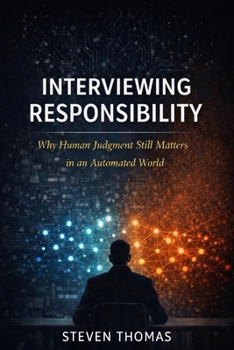
Interviewing Responsibility: Why Human Judgment Still Matters in an Automated World

Who is responsible when no one appears to be in control?
As automated systems increasingly shape decisions across institutions, responsibility is often described as something that can be distributed, embedded, or deferred. In practice, it is more often displaced-hidden behind process, metrics, and technical language.
Interviewing Responsibility examines what happens when accountability fades in complex, automated environments and why human judgment remains indispensable. Rather than focusing on tools or technical fixes, this book confronts a harder question: where responsibility truly resides when decisions are made by systems, approved by procedure, and justified after the fact.
This final volume in the Interviewing series argues that responsibility cannot be engineered into automation or absorbed by workflow. It must be explicitly owned. Through clear, direct analysis, the book explores delegation, oversight, refusal, judgment under constraint, and the moral cost of efficiency when accountability is sacrificed for speed.
Written for leaders, professionals, and anyone navigating decision-making in institutional or automated settings, Interviewing Responsibility challenges the assumption that better systems automatically produce better outcomes-and asks what it means to remain responsible when the system provides an answer, but not ownership.
Responsibility does not disappear when it is unnamed.
It only becomes harder to find.
Customer Reviews
ThriftBooks ® and the ThriftBooks ® logo are registered trademarks of Thrift Books Global, LLC
