


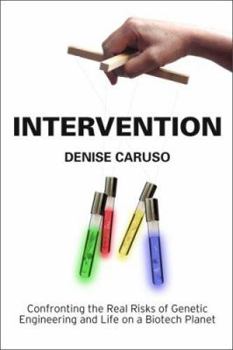
Intervention: Confronting the Real Risks of Genetic Engineering and Life on a Biotech Planet

Select Format
Select Condition 
Book Overview
INTERVENTION challenges two of the most sacred tenets of modern society, innovation and technology, from the perspective of the unique risks they present. Using genetic engineering as its model, it... This description may be from another edition of this product.
Format:Paperback
Language:English
ISBN:0615135536
ISBN13:9780615135533
Release Date:November 2006
Publisher:Published by You Lulu Inc.
Length:272 Pages
Weight:0.89 lbs.
Dimensions:0.6" x 6.0" x 9.0"
Related Subjects
Evolution Genetics Science Science & Math Science & Scientists Science & TechnologyCustomer Reviews
5 ratings
Asilomar was in 1975. Now what?
Published by Thriftbooks.com User , 18 years ago
In Intervention, Denise Caruso, a columnist for the New York Times, has written an important and timely book. The set of people who need to read it include but are not limited to policymakers and voters in the US, in the affluent world, and in the developing world. Intervention is mainly about transgenic organisms. One of the numerous unsolved problems people need to tackle this century is devising a workable regulatory framework for transgenic plants and animals, aka genetically modified organisms, aka organisms into which engineers have dropped pieces of DNA. In the US, the existing regulatory regime is a patchwork. The biggest part of the patchwork comes from at the dawn of recombinant DNA work at the Asilomar conference in 1975. Asilomar led directly to the "NIH guidelines". These guesstimated different levels of potential risk for different kinds of recombinant DNA experiments, mandated lab practices and levels of containment to conduct research at each level, and set up bodies for review and approval of experiments local to each university. Asilomar also brought about the establishment of an overarching national body, the Recombinant Advisory Committee (aka RAC) to rule on the appropriate level of containment for contested experiments, and established mechanisms by which levels of containment could be ratcheted up or down in response to information coming from new experiments, which in practice has led to sunset of most of the most burdensome regulations as the feared risks did not materialize. The regulatory framework affected experiments in universities funded by the US government, but was extended to commercial work via local communities. Individual cities caused, via their control of zoning, biotech firms to follow the NIH rules. Most of this "Asilomar framework" governs recombinant DNA research in lab organisms such as E. coli, yeast, and mice. In the US, use of recombinant DNA in people, for example in gene therapy, is regulated by the FDA, and release of an organism into the environment, for example a herbicide-resistant potato or an oil-eating bacterium, is regulated by the EPA. Recombinant work is also regulated in other advanced countries, but in no country is there a system of local and national oversight as strong as that in the US. And the US framework, 32 years old, is fraying at the seams. It is showing its age by showing gaps. Many of the issues are due to the Moore's-law-like growth in the scope and power of the technologies, the democratization of the technical ability to hack DNA, the adoption of recombinant DNA methods by new classes of hackers , and the use of recombinant DNA to engineer different classes of organisms. The Asilomar framework was designed to regulate research in universities and, extended by zoning regulations, in companies. The Asilomar framework was not designed for a world in which the number of people with basic training in recombinant DNA methods has increased from hundreds to
Sobering "Hold on a minute...let's think carefully about what we're doing"
Published by Thriftbooks.com User , 18 years ago
Just because we can genetically engineer things doesn't mean that there aren't any consequences. In this passionately argued treatise, Caruso provides a welcome antidote to the boosters of biotech. She's not anti-genetic engineering per se, but wants us to truly debate the consequences. Caruso calls upon readers not to merely accept the words of government and industry to "trust us, everything will be fine." Recommended.
Essential Reading
Published by Thriftbooks.com User , 18 years ago
Caruso is trying to operate in the difficult space between unquestioning supporters of biotech and reflexive opponents of the technology. Her careful examination of the regulatory process becomes an indictment of it, but also points a way towards reform. The book is particularly good on questioning both the "benefit" and the "risk" sides of the risk/benefit equation, and in pointing out the repeated tendency of regulators to look only at what they know they can see, rather than asking deeping and wider questions. I gather that the original publisher backed away from the book because it was not sensational enough. That in itself is an indictment not only of publishing but of our civil discourse, because this is an important book that deserves a wide audience. Scientists should read it to get a broader perspective; non-scientists should read it because we are all being affected by decisions on the use of biotechnology.
This a great, important and accessible book
Published by Thriftbooks.com User , 19 years ago
This a great book - well thought out, written and informative. The title may sound intimidating, but the content is very accessible. I like having a fairly complete and accurate picture to understand an issue that is important to me. Food safety and disease avoidance are important to me. Denise Caruso's Intervention gave me a clear, rationally and historically grounded understanding of the issues surrounding our latest capabilities to alter our environment, AND how the government should move forward to better protect Americans. I enjoy having a framework, with facts, to better understand biotech and my world. This book is a great and important read for everyone interested in maintaining a livable biosphere for humans.
A thoughtful analysis of a difficult issue
Published by Thriftbooks.com User , 19 years ago
Denise Caruso successsfully brings her considerable writing and science policy skills to bear on a fundamentally important issue. Society is confronted by increasingly complex and difficult decisions as science progresses and the scientific community itself is seldom well equipped or credible to serve as the advocate. Caruso provides a critical bridge between the advances of science and the needs and values of society.
Copyright © 2026 Thriftbooks.com Terms of Use
| Privacy Policy | Do Not
Sell/Share My Personal Information | Cookie Policy | Cookie Preferences | Accessibility Statement
ThriftBooks® and the ThriftBooks® logo are registered trademarks of Thrift Books Global, LLC
ThriftBooks® and the ThriftBooks® logo are registered trademarks of Thrift Books Global, LLC
