


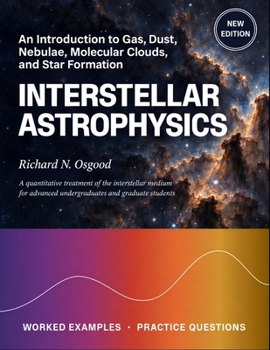
INTERSTELLAR ASTROPHYSICS: An Introduction to Gas, Dust, Nebulae, Molecular Clouds, and Star Formation

Turn an observed spectral line into a physical condition: a temperature, a density, a column density, a velocity.
That conversion is the working skill at the center of interstellar medium astrophysics, and it is where most study of the subject quietly stops. Recognizing the vocabulary of a field is not the same as being able to compute with it. Plenty of readers can define optical depth or name the phases of the interstellar medium, and still stall when asked to extract a turbulent velocity from a measured line width or decide whether an observed line is reporting density or temperature.
This book was written to close that gap. Across 18 chapters it develops the physics of the interstellar medium from first principles, in a deliberate order, and carries every worked example through to a final number with units tracked from the first line to the last.
Interpret interstellar spectra: Solve the radiative transfer equation, separate optically thin from optically thick behavior, use the critical density of a transition, and split thermal from turbulent contributions to a line width.Measure gas and cloud properties: Convert 21 cm brightness temperature into a neutral hydrogen column density, estimate molecular cloud masses from carbon monoxide emission, and read electron temperature and density from nebular line ratios.Use dust as an observational tool: Relate color excess to visual extinction, fit far-infrared and submillimeter emission with modified blackbodies, estimate grain equilibrium temperatures, and connect grain alignment to polarized light.Trace the chemistry of molecular clouds: Follow hydrogen formation on grain surfaces, molecular self-shielding, ion-molecule reactions and freeze-out, and learn why some molecular gas stays dark to carbon monoxide.Decide whether a cloud will collapse: Apply Jeans instability, free-fall times and the virial theorem, and weigh how turbulence and magnetic fields support a cloud or drive its fragmentation.Follow the birth and influence of stars: Connect the stellar initial mass function to protostellar stages, accretion luminosity, disk formation and jets, then examine how photoionization, stellar winds and supernovae regulate what forms next.Build the galactic picture: Work with Zeeman and Chandrasekhar-Fermi magnetic field diagnostics, cosmic ray ionization, shocks and supernova remnants, and the near-far ambiguity in Galactic distances.Built for study and for reference. Every chapter opens with learning objectives and closes with practice problems and answers. A glossary, an index, an appendix of physical constants, solar values and unit conversions, and a chapter-by-chapter collection of key equations are there for the work itself. The text is self-contained and carries no citation apparatus or reading list, so readers pursuing research-grade work should consult the current literature alongside it.
It assumes a standard undergraduate physics background and builds the rest, which suits upper-level undergraduates, graduate students entering the field, and researchers in neighboring areas who need working command of interstellar medium physics rather than a general acquaintance with it.
Open the first chapter and begin turning the physics of the interstellar medium into calculations you can carry out yourself.
Customer Reviews
ThriftBooks ® and the ThriftBooks ® logo are registered trademarks of Thrift Books Global, LLC
