


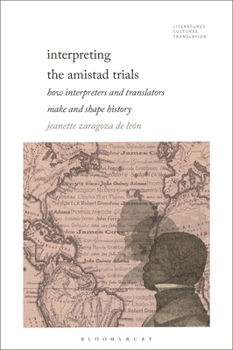
Interpreting the Amistad Trials: How Interpreters and Translators Make and Shape History
No Customer Reviews

Interpreting TheAmistad Trialstraces the signal importance of interpreters and translators in the famous 19th-century Amistadcase and discusses how race, ethnicity, slavery, and colonialism shaped this story.
From the recruitment process to the various oral to sign languages that mediated linguistically in the Africans' life inside and outside the courtroom, and from evidentiary documents to fraudulent translations to credible testimonies, Jeanette Zaragoza-De Le n demonstrates the crucial importance of translation and interpretation in the Amistad plot and outcome. De Le n examines handwritten letters, pamphlets, newspapers, and judicial files, and adopts a critical race theory and postcolonial lens to analyze these materials. Although these critical interpretations and translations travelled transatlantically via Europe, Africa, the Caribbean, and the United States, De Le n highlights the common thread which also geographically unites Venezuela, Puerto Rico, and the Dominican Republic as part of the Amistadstory.
One of the most comprehensive studies of recorded events in the history of interpretation and translation in the Americas, Interpreting TheAmistad Trialsis a valuable resource for researchers studying coloniality, enslavement, race and ethnic studies and examining how these issues mattered then and now.
From the recruitment process to the various oral to sign languages that mediated linguistically in the Africans' life inside and outside the courtroom, and from evidentiary documents to fraudulent translations to credible testimonies, Jeanette Zaragoza-De Le n demonstrates the crucial importance of translation and interpretation in the Amistad plot and outcome. De Le n examines handwritten letters, pamphlets, newspapers, and judicial files, and adopts a critical race theory and postcolonial lens to analyze these materials. Although these critical interpretations and translations travelled transatlantically via Europe, Africa, the Caribbean, and the United States, De Le n highlights the common thread which also geographically unites Venezuela, Puerto Rico, and the Dominican Republic as part of the Amistadstory.
One of the most comprehensive studies of recorded events in the history of interpretation and translation in the Americas, Interpreting TheAmistad Trialsis a valuable resource for researchers studying coloniality, enslavement, race and ethnic studies and examining how these issues mattered then and now.
Format:Hardcover
Language:English
ISBN:1501394606
ISBN13:9781501394607
Release Date:October 2025
Publisher:Bloomsbury Academic
Length:272 Pages
Weight:1.01 lbs.
Dimensions:0.6" x 5.5" x 8.5"
Customer Reviews
0 rating
Copyright © 2026 Thriftbooks.com
Terms of Use | Privacy Policy | Do Not Sell/Share My Personal Information | Cookie Policy | Cookie Preferences | Accessibility Statement
ThriftBooks ® and the ThriftBooks ® logo are registered trademarks of Thrift Books Global, LLC
ThriftBooks ® and the ThriftBooks ® logo are registered trademarks of Thrift Books Global, LLC
