


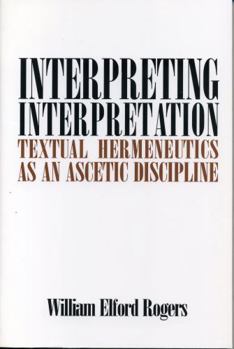
Interpreting Interpretation: Textual Hermeneutics as an Ascetic Discipline

Select Format
Select Condition 
Book Overview
In Interpreting Interpretation, William E. Rogers searches for a model for literary education. This model should avoid both of two undesirable alternatives. First, it should not destroy any notion of discipline in the traditional sense, terminating in the stance of Rorty's "liberal ironist." Second, it should not regard literary education as an attempt to cause students to ingest a pre-determined mix of facts and cultural values, terminating in the stance of E. D. Hirsch's "cultural literate." From the semiotics of C. S. Peirce, Rogers develops the notion of interpretive system. The interpretive system called textual hermeneutics is used to interpret interpretation. From that perspective, the world looks like a text. Applying the principle rigorously allows an articulation of the problematic relations among interpretation, philosophy, and language itself.
Interpreting Interpretation clarifies the conception of textual hermeneutics as an ascetic discipline by showing the consequences of this conception for interpreting canonical texts and for humanities education in general. Discussions of poetry by Robert Frost and by John Ashbery illustrate how this conception applies to an analysis of literary texts. Ultimately, the book offers a Peircean alternative to the educational theories implied in the pragmatism of John Dewey and of Richard Rorty. Rogers provides a new vocabulary for talking about what people are doing when they read, write, speak, and hear interpretive statements about texts. The new vocabulary acknowledges the great difficulty of "teaching texts" in the face of postmodern anxieties about pluralism, relativism, or nihilism. What emerges is not curriculum but method--an argument that the humanities teach not texts but interpretive systems.
Customer Reviews
ThriftBooks® and the ThriftBooks® logo are registered trademarks of Thrift Books Global, LLC
