


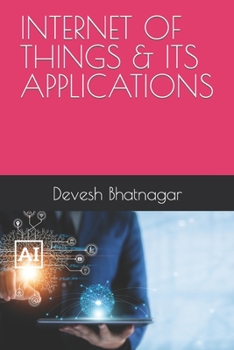
Internet of Things & Its Applications
No Customer Reviews

Internet of Things (IoT) is the networking of physical objects that contain electronics embedded within their architecture in order to communicate and sense interactions amongst each other or with respect to the external environment. In the upcoming years, IoT-based technology will offer advanced levels of services and practically change the way people lead their daily lives. Advancements in medicine, power, gene therapies, agriculture, smart cities, and smart homes are just a very few of the categorical examples where IoT is strongly established. Over 9 billion 'Things' (physical objects) are currently connected to the Internet, as of now. In the near future, this number is expected to rise to a whopping 20 billion.
There are four main components used in IoT:
Low-power embedded systems: Less battery consumption, high performance are the inverse factors that play a significant role during the design of electronic systems.
Cloud computing: Data collected through IoT devices is massive and this data has to be stored on a reliable storage server. This is where cloud computing comes into play. The data is processed and learned, giving more room for us to discover where things like electrical faults/errors are within the system.
Availability of big data: We know that IoT relies heavily on sensors, especially in real-time. As these electronic devices spread throughout every field, their usage is going to trigger a massive flux of big data.
Networking connection: In order to communicate, internet connectivity is a must where each physical object is represented by an IP address. However, there are only a limited number of addresses available according to the IP naming. Due to the growing number of devices, this naming system will not be feasible anymore. Therefore, researchers are looking for another alternative naming system to represent each physical object.
There are two ways of building IoT:
- Form a separate internetwork including only physical objects.
- Make the Internet ever more expansive,
There are four main components used in IoT:
Low-power embedded systems: Less battery consumption, high performance are the inverse factors that play a significant role during the design of electronic systems.
Cloud computing: Data collected through IoT devices is massive and this data has to be stored on a reliable storage server. This is where cloud computing comes into play. The data is processed and learned, giving more room for us to discover where things like electrical faults/errors are within the system.
Availability of big data: We know that IoT relies heavily on sensors, especially in real-time. As these electronic devices spread throughout every field, their usage is going to trigger a massive flux of big data.
Networking connection: In order to communicate, internet connectivity is a must where each physical object is represented by an IP address. However, there are only a limited number of addresses available according to the IP naming. Due to the growing number of devices, this naming system will not be feasible anymore. Therefore, researchers are looking for another alternative naming system to represent each physical object.
There are two ways of building IoT:
- Form a separate internetwork including only physical objects.
- Make the Internet ever more expansive,
Format:Paperback
Language:English
ISBN:9357803653
ISBN13:9789357803656
Release Date:December 2022
Publisher:Self Publisher
Length:236 Pages
Weight:0.71 lbs.
Dimensions:0.5" x 6.0" x 9.0"
Customer Reviews
0 rating
Copyright © 2026 Thriftbooks.com
Terms of Use | Privacy Policy | Do Not Sell/Share My Personal Information | Cookie Policy | Cookie Preferences | Accessibility Statement
ThriftBooks ® and the ThriftBooks ® logo are registered trademarks of Thrift Books Global, LLC
ThriftBooks ® and the ThriftBooks ® logo are registered trademarks of Thrift Books Global, LLC
