


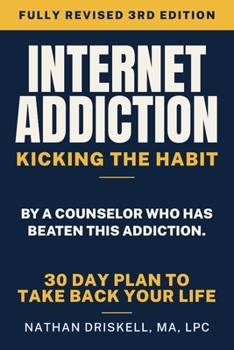
Internet Addiction: Kicking the Habit: 30 Day Plan To Take Back Your Life

Select Format
Select Condition 
Book Overview
You meant to check one thing. That was ninety minutes ago, and you cannot account for any of it.
You know the number on your screen time report is wrong, because you stopped looking at it. You have promised your partner, or your child, or yourself. It held for a few days. It always holds for a few days, then one evening you are back, and the worst part is, you weren't even enjoying it. You feel stuck, and are tired of this game with yourself.
I know exactly how you got here. I spent six years inside an online game - twelve to fourteen hours a day, through most of college. Within the game, I had friends, money, status, and a life I thought had meaning. I told myself addicts were people who lived under bridges. I told myself I had put six years in and was too invested to walk away now. I had to walk away, without a guide, a book, a therapist. I did it all on my own. You do not have to.
Sixteen years ago I became a licensed counselor and started treating this for a living. So this book is written from both sides - by someone who knows what the lie sounds like from the inside, and who has since sat across from hundreds of people telling it.
Here is what it actually is.
Three short chapters first, on how screens hijack your brain and why this is harder now than it has ever been. Then thirty days, each one a five-to-ten-minute read with a single activity that tells you upfront what it costs-usually fifteen to thirty minutes. Four of the days ask nothing new; you just run what you have built. Then a final section, The Next 90 Days, for the part after the program ends.
Along the way, you will inventory every device you own and read your real usage data. You will name what the addiction is actually giving you, and find somewhere else to get it. You will build sleep, mornings, and evenings. You will remove apps in four stages, set a ceiling on your evenings, get out of the house, learn eight things to do when an urge hits, answer the thoughts that keep you stuck, and go see one person you have been avoiding.
It all goes in a paper binder. In a book about screens, that is deliberate.
I will not promise you a cure. Thirty days does not do that. I am twenty years out and still get urges. What thirty days does is leave you standing on something: a sleep schedule you keep, people on your calendar, your worst applications gone, real limits on the rest, and an honest reckoning with what this has cost. Most people fighting this never get that far.
And when you slip - you will - the last section tells you what it will actually look like. Not a dramatic collapse. A window creeping ten minutes, then twenty. The phone back on the nightstand for one good reason. You will learn to see it early, and what to do in the twenty-four hours after.
If you miss a day, do not start over. Restarting feels like commitment. For an addict, it is usually a way of quitting while keeping your self-image intact. Pick up where you left off.
You do not have to like the word addict. You do have to be honest that the pattern is real. If you have read this far, part of you already is.
Thirty days to build it. Ninety to keep it.
Fully revised and expanded third edition.
Nathan Driskell, MA, LPC, specializes in internet, gaming, and screen addiction, and in teens and adults with high-functioning autism. Texas LPC #66397.
Customer Reviews
ThriftBooks ® and the ThriftBooks ® logo are registered trademarks of Thrift Books Global, LLC
