


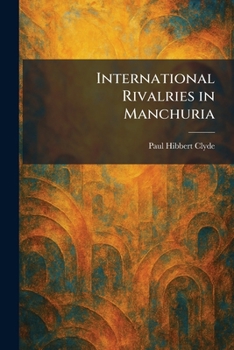
International Rivalries in Manchuria

Select Format
Select Condition 
Book Overview
"International Rivalries in Manchuria" is a comprehensive historical and diplomatic analysis of the intense geopolitical competition centered in the Manchurian region during the late 19th and early 20th centuries. Author Paul Hibbert Clyde meticulously explores the strategic interests and conflicts involving major global powers, including China, Japan, Russia, and Western nations, as they vied for influence and territorial control in Northeast Asia.
The work provides a detailed examination of the treaties, railway concessions, and military confrontations-most notably the Russo-Japanese War-that transformed Manchuria into a critical flashpoint of international relations. By tracing the evolution of the Open Door policy and the shifting alliances of the era, Clyde offers readers a profound understanding of the complex political dynamics that preceded the broader global conflicts of the 20th century.
This scholarly study remains an essential resource for those interested in Asian history, the history of diplomacy, and the origins of modern international tensions in the Far East. "International Rivalries in Manchuria" stands as a rigorous exploration of how regional struggles can mirror and shape the course of world history.
This work has been selected by scholars as being culturally important, and is part of the knowledge base of civilization as we know it. This work was reproduced from the original artifact, and remains as true to the original work as possible. Therefore, you may see the original copyright references, library stamps (as most of these works have been housed in our most important libraries around the world), and other notations in the work.
This work is in the public domain in the United States of America, and possibly other nations. Within the United States, you may freely copy and distribute this work, as no entity (individual or corporate) has a copyright on the body of the work.
As a reproduction of a historical artifact, this work may contain missing or blurred pages, poor pictures, errant marks, etc. Scholars believe, and we concur, that this work is important enough to be preserved, reproduced, and made generally available to the public. We appreciate your support of the preservation process, and thank you for being an important part of keeping this knowledge alive and relevant.
Customer Reviews
ThriftBooks ® and the ThriftBooks ® logo are registered trademarks of Thrift Books Global, LLC
