


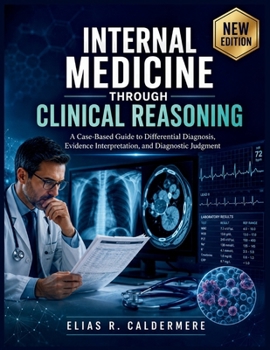
Internal Medicine Through Clinical Reasoning: A Case-Based Guide to Differential Diagnosis, Evidence Interpretation, and Diagnostic Judgment

Internal medicine becomes far more manageable when symptoms, signs, laboratory results, imaging findings, and disease mechanisms begin to connect into one clear clinical story.
Do you ever know the medical facts but struggle to turn them into a focused differential diagnosis? Have you looked at a complicated patient and wondered which finding actually matters most? Do you want to become more confident explaining why one diagnosis fits better than another?
Internal Medicine Through Clinical Reasoning was created to help bridge that gap.
Rather than presenting internal medicine as an endless catalogue of diseases to memorize, this comprehensive textbook teaches you how to reason from the patient's presentation toward a disciplined diagnostic conclusion. Step by step, it shows how foundational science, probability, history, examination, investigations, pathophysiology, and cognitive awareness work together at the bedside.
Inside, you will learn how to:
Build concise, high-value problem representations from complex clinical informationGenerate, prioritize, and refine differential diagnoses without premature closureUnderstand pretest probability, sensitivity, specificity, likelihood ratios, and post-test probabilityInterpret laboratory and imaging findings in clinical context instead of treating abnormalities in isolationReason through fever, fatigue, chest pain, dyspnea, syncope, edema, abdominal pain, jaundice, gastrointestinal bleeding, kidney dysfunction, neurologic presentations, anemia, endocrine disorders, and systemic inflammationRecognize anchoring, confirmation bias, diagnostic momentum, and other cognitive trapsCommunicate diagnostic uncertainty clearly and reassess difficult cases as new evidence appearsReinforce learning through realistic medical illustrations, clinical correlations, cases, summaries, and practice questions with explained answersHere is a glimpse of what makes this book different: a near-normal pH does not always mean acid-base balance is normal, a negative test does not automatically rule out disease, and a familiar symptom pattern can become misleading when one crucial detail does not fit. Throughout the book, cases are built around these moments-the places where clinical reasoning matters most.
Worried that clinical reasoning books are too abstract, statistically intimidating, or disconnected from real medicine?
This book is designed to be practical and progressive. Quantitative concepts are explained in clinical language, complex mechanisms are supported by full-colour illustrations, and cases move from presentation to diagnostic synthesis without overwhelming the reader with unnecessary therapeutic protocols.
Whether you are a clinical medical student, intern, resident, early-career physician, or educator, this book can become a dependable companion for rounds, revision, case discussions, and deeper study.
It also makes a thoughtful and practical gift for a medical student or resident who wants internal medicine explained in a clearer, more visual, and easier-to-follow way.
Stop memorizing disconnected facts. Start seeing the patterns. Start questioning the evidence. Start reasoning through the patient.
Add Internal Medicine Through Clinical Reasoning to your medical library today and begin building the diagnostic judgment that transforms medical knowledge into meaningful clinical understanding.
Your next difficult case will demand more than memory. Give yourself the framework to think it through-GET YOUR COPY TODAY.Customer Reviews
ThriftBooks ® and the ThriftBooks ® logo are registered trademarks of Thrift Books Global, LLC
