


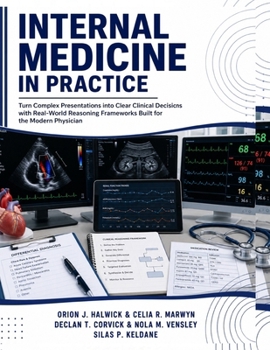
Internal Medicine in Practice: Turn Complex Presentations into Clear Clinical Decisions with Real-World Reasoning Frameworks Built for the Modern Phys

Internal Medicine in Practice is a clinical reasoning guide for the cases that do not present neatly.
Adult patients often arrive with overlapping symptoms, abnormal test results, medication effects, chronic disease, and risk factors that point in more than one direction. The challenge is not only to know the possible diagnoses. It is to decide which problem is most important, which diagnosis cannot be missed, and what next step is justified by the evidence in front of you.
What This Book Helps You DoClarify the clinical problem
Turn vague or complex presentations into a focused problem representation that guides the differential diagnosis.
Separate likely from dangerous
Identify common diagnoses, high-risk alternatives, red flags, and findings that should change urgency or disposition.
Use data with purpose
Interpret vital signs, laboratory trends, imaging findings, medication history, comorbidities, and treatment response in clinical context.
Build practical management plans
Connect diagnosis with acute treatment, chronic disease control, prevention, medication safety, monitoring, and follow-up.
Reassess when the case changes
Recognize when the first explanation no longer fits and when new information should redirect the plan.
- Real-world reasoning frameworks for common adult-medicine presentations
- Symptom-based approaches to chest pain, dyspnea, fever, fatigue, edema, anemia, confusion, abdominal pain, weight loss, and abnormal laboratory findings
- Clinical pathways across cardiovascular, respiratory, renal, endocrine, gastrointestinal, neurologic, hematologic, infectious, rheumatologic, and multisystem disease
- Decision checkpoints for diagnosis, severity assessment, escalation, treatment response, and follow-up
- Practical guidance for inpatient care, outpatient assessment, multimorbidity, medication review, and complex chronic illness
Written for medical students, residents, internists, hospitalists, advanced practice providers, and serious adult-medicine learners, Internal Medicine in Practice is designed to strengthen the way clinicians think through uncertainty.
It is not a book of isolated disease summaries. It is a structured guide to turning complex presentations into clearer, safer, and more defensible clinical decisions.
Current internal-medicine assessment frameworks emphasize diagnostic reasoning, clinical judgment, and appropriate diagnostic and management decisions-skills this book is designed to support.
Customer Reviews
ThriftBooks ® and the ThriftBooks ® logo are registered trademarks of Thrift Books Global, LLC
