


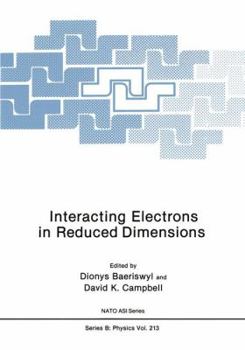
Interacting Electrons in Reduced Dimensions
No Customer Reviews

Select Format
Select Condition 
Book Overview
As its name suggests, the 1988 workshop on "Interacting Electrons in Reduced Dimen- the wide variety of physical effects that are associated with (possibly sions" focused on strongly) correlated electrons interacting in quasi-one- and quasi-two-dimensional mate- rials. Among the phenomena discussed were superconductivity, magnetic ordering, the metal-insulator transition, localization, the fractional Quantum Hall effect (QHE), Peierls and spin-Peierls transitions, conductance fluctuations and sliding charge-density (CDW) and spin-density (SDW) waves. That these effects appear most pronounced in systems of reduced dimensionality was amply demonstrated at the meeting. Indeed, when concrete illustrations were presented, they typically involved chain-like materials such as conjugated polymers, inorganic CDW systems and organie conductors, or layered materials such as high-temperature copper-oxide superconductors, certain of the organic superconductors, and the QHE samples, or devices where the electrons are confined to a restricted region of sample, e. g., the depletion layer of a MOSFET. To enable this broad subject to be covered in thirty-five lectures (and ab out half as many posters), the workshop was deliberately focused on theoretical models for these phenomena and on methods for describing as faithfully as possible the "true" behav- ior of these models. This latter emphasis was especially important, since the inherently many-body nature of problems involving interacting electrons renders conventional effec- tive single-particle/mean-field methods (e. g., Hartree-Fock or the local-density approxi- mation in density-functional theory) highly suspect. Again, this is particularly true in reduced dimensions, where strong quantum fluctuations can invalidatemean-field results.
Format:Paperback
Language:English
ISBN:1461278694
ISBN13:9781461278696
Release Date:December 2011
Publisher:Springer
Length:414 Pages
Weight:1.60 lbs.
Dimensions:0.9" x 7.0" x 10.0"
Related Subjects
Engineering Science Science & Math Science & Scientists Science & Technology TechnologyCustomer Reviews
0 rating
Copyright © 2026 Thriftbooks.com Terms of Use
| Privacy Policy | Do Not
Sell/Share My Personal Information | Cookie Policy | Cookie Preferences | Accessibility Statement
ThriftBooks® and the ThriftBooks® logo are registered trademarks of Thrift Books Global, LLC
ThriftBooks® and the ThriftBooks® logo are registered trademarks of Thrift Books Global, LLC
