


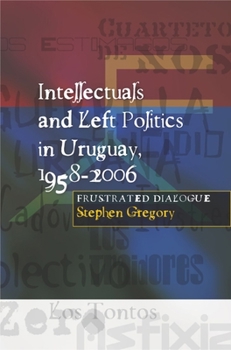
Intellectuals and Left Politics in Uruguay, 1958-2006
No Customer Reviews

Beginning in the year Uruguayans elected a different party into government for the first time in nearly a century, the author examines intellectuals' role in the Uruguayan left's drive toward unity and effectiveness. Discussion focuses on fragmentation and impotence on the left; frustrated attempts at left unity in the 1960s; the creation of the centre-left Broad Front in 1971; and the defeat of all left endeavours and all dialogue in the 1973 military coup -- a prelude to a twelve-year dictatorship in which the military substituted themselves for intellectuals. The story continues in 1985, reversing the earlier trend in a record of dispersal and diversity. The author details the initial post-authoritarian anarchic cultural outburst -- part celebration, part frustration; intellectuals' role in the disputes that accompanied the Broad Front's move from democratic socialism to social democracy, and from opposition to government in 2004; and recent excursions into the long-standing Uruguayan obsession with its identity and viability as an independent nation. This book is essential reading for all those interested in interplay between intellectuals and politics in Latin America; changes in the Latin American left since the 1960s; and the leftward drift of elected governments in the Southern Cone.
Format:Hardcover
Language:English
ISBN:1845192656
ISBN13:9781845192655
Release Date:March 2009
Publisher:Liverpool University Press
Length:234 Pages
Weight:1.05 lbs.
Dimensions:0.8" x 6.2" x 9.1"
Customer Reviews
0 rating
Copyright © 2026 Thriftbooks.com Terms of Use
| Privacy Policy | Do Not
Sell/Share My Personal Information | Cookie Policy | Cookie Preferences | Accessibility Statement
ThriftBooks® and the ThriftBooks® logo are registered trademarks of Thrift Books Global, LLC
ThriftBooks® and the ThriftBooks® logo are registered trademarks of Thrift Books Global, LLC
