


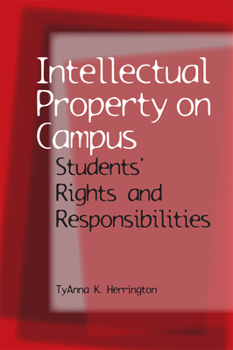
Intellectual Property on Campus: Students' Rights and Responsibilities
No Customer Reviews

What issues arise when students' uses of intellectual materials are legally challenged, and how does the academic context affect them? What happens when users of intellectual property, either within or outside the academic structure, violate students' rights to their intellectual products? In Intellectual Property on Campus, TyAnna K. Herrington addresses these concerns and more, clearing up the confusion often surrounding intellectual property law and its application in an academic setting. Filled with practical information and simple yet thorough explanations, this enlightening volume provides educators and students with a solid basis for understanding the broader impacts of legal and ethical dilemmas involving intellectual materials.
Herrington provides insight for students into how complex concepts such as patent, trademark, copyright, fair use, and plagiarism affect their work. She outlines the potential effects of the choices students make, as well as the benefits and limitations of legal protection for intellectual property, including the thorny issues of authorship and authority under the 1976 Copyright Act. Herrington also explores the topic of student collaboration--now very common on college campuses--and how it affects intellectual property issues and legal relationships, as well as the impact of new technologies, such as blogs, on student work in educational environments.Intellectual Property on Campus also provides useful information for administrators and educators. In particular, Herrington investigates the possible ramifications of their pedagogical and policy choices, and examines in depth the responsibility of instructors to treat students' intellectual property legally, ethically, and conscientiously. Cautioning educators about the limitations on their control over intellectual materials in an academic setting, Herrington encourages teachers to minimize their influence over student works, instead giving pupils more freedom to control their own creations.
The volume also investigates the rights, responsibilities, and limitations for users of intellectual property, as opposed to creators, especially as related to student or instructor use of copyrighted materials. Discussed in detail are such issues as fair use and the TEACH Act, as well as the often-intertwined areas of plagiarism, authorship, and copyright. In addition, Herrington addresses recent cultural developments regarding the use and creation of intellectual property by students and instructors.
Written in a jargon-free style that is easy to understand, Intellectual Property on Campus gives students, instructors, and administrators the information they need to navigate the intricate landscape of law and integrity in the realm of academic creation.
Format:Paperback
Language:English
ISBN:080932993X
ISBN13:9780809329939
Release Date:October 2010
Publisher:Southern Illinois University Press
Length:152 Pages
Weight:0.50 lbs.
Dimensions:0.4" x 6.0" x 8.9"
Customer Reviews
0 rating
Copyright © 2026 Thriftbooks.com Terms of Use
| Privacy Policy | Do Not
Sell/Share My Personal Information | Cookie Policy | Cookie Preferences | Accessibility Statement
ThriftBooks® and the ThriftBooks® logo are registered trademarks of Thrift Books Global, LLC
ThriftBooks® and the ThriftBooks® logo are registered trademarks of Thrift Books Global, LLC
