


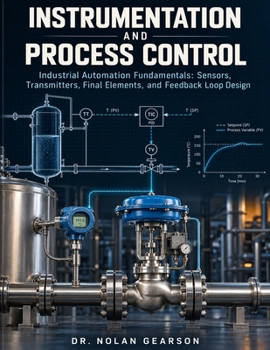
Instrumentation And Process Control: Industrial Automation Fundamentals Sensors, Transmitters, Final Elements, and Feedback Loop Design

Modern industrial facilities depend on precise measurements, reliable instrumentation, and effective control systems to maintain safety, efficiency, and consistent performance. From chemical processing plants and petroleum refineries to power stations and water treatment facilities, understanding how sensors, transmitters, controllers, and final control elements work together is essential for successful industrial operations.
Instrumentation and Process Control provides a systematic, practical, and technically rigorous introduction to the principles, equipment, and engineering methods behind modern industrial automation.
Written for engineering students, instrumentation technicians, and practicing professionals, this textbook bridges the gap between theoretical control concepts and real-world industrial applications. It explains not only how individual instruments function, but also how measurement systems, signal transmission, process dynamics, control algorithms, and automation technologies interact to form reliable closed-loop control systems.
Beginning with the foundations of measurement and industrial instrumentation, the book progressively develops the knowledge required to understand, analyze, design, calibrate, tune, and troubleshoot process control loops.
WHAT YOU WILL LEARNIndustrial Instrumentation and Measurement Principles: Understand pressure, temperature, flow, and level measurement, including sensor operating principles, instrument selection, measurement accuracy, uncertainty, and calibration.
Transmitters and Industrial Signal Systems: Explore signal conditioning, 4-20 mA current loops, HART communication, industrial fieldbus networks, and the transmission of measurement information between field instruments and control systems.
Control Valves and Final Control Elements: Learn about control valve construction, operating characteristics, sizing calculations, pneumatic actuators, valve positioners, and the practical factors that influence control performance.
Process Dynamics and Mathematical Modeling: Develop an understanding of process gain, time constants, dead time, transfer functions, and dynamic response through engineering models and worked calculations.
Feedback Control and PID Algorithms: Understand proportional, integral, and derivative control, controller action, closed-loop stability, and the principles used to regulate industrial processes.
Controller Tuning and Advanced Control Strategies: Explore practical PID tuning methods, loop performance evaluation, cascade control, feedforward control, ratio control, and other regulatory control techniques.
PLC, DCS, and SCADA Systems: Examine programmable logic controllers, distributed control systems, operator interfaces, industrial communication networks, and the architecture of modern automation systems.
Process Safety and Reliable Operation: Gain insight into alarm management, safety instrumented systems, protective layers, equipment failures, and the engineering practices used to maintain safe industrial operations.
A PRACTICAL, ENGINEERING-FOCUSED LEARNING EXPERIENCERather than presenting instrumentation and control theory as isolated subjects, this book follows the complete flow of information and action through an industrial control loop-from the initial process measurement to the controller's decision and the physical response of the final control element.
Throughout the chapters, clear technical explanations, engineering equations, worked numerical examples, diagrams, practice problems, and troubleshooting discussions help readers connect fundamental principles with practical engineering decisions.
Customer Reviews
ThriftBooks ® and the ThriftBooks ® logo are registered trademarks of Thrift Books Global, LLC
