


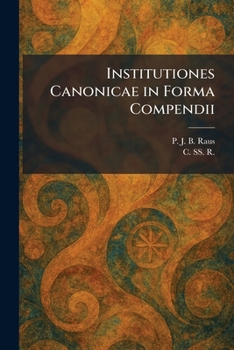
Institutiones Canonicae in Forma Compendii

"Institutiones Canonicae in Forma Compendii" is a rigorous and structured manual providing a systematic overview of the laws and regulations of the Catholic Church. Authored by P. J. B. Raus, a member of the Congregation of the Most Holy Redeemer (C.SS.R.), this work serves as a comprehensive compendium for students and practitioners of ecclesiastical law. Following the early 20th-century codification of church law, such texts were essential for understanding the administrative, judicial, and sacramental discipline of the Church.
The work covers fundamental principles of canon law, including the sources of law, the hierarchy of the Church, the administration of sacraments, and the penal system. By presenting these complex legal concepts in a condensed compendium format, Raus offers a clear and accessible guide to the internal legal system that governs the clergy and the laity. This volume is a significant historical resource for those interested in the development of Catholic jurisprudence and the structural organization of the Church. "Institutiones Canonicae in Forma Compendii" remains an important primary source for understanding the legal framework that shaped Catholic life and institutional practice during the post-1917 era.
This work has been selected by scholars as being culturally important, and is part of the knowledge base of civilization as we know it. This work was reproduced from the original artifact, and remains as true to the original work as possible. Therefore, you may see the original copyright references, library stamps (as most of these works have been housed in our most important libraries around the world), and other notations in the work.
This work is in the public domain in the United States of America, and possibly other nations. Within the United States, you may freely copy and distribute this work, as no entity (individual or corporate) has a copyright on the body of the work.
As a reproduction of a historical artifact, this work may contain missing or blurred pages, poor pictures, errant marks, etc. Scholars believe, and we concur, that this work is important enough to be preserved, reproduced, and made generally available to the public. We appreciate your support of the preservation process, and thank you for being an important part of keeping this knowledge alive and relevant.
Customer Reviews
ThriftBooks ® and the ThriftBooks ® logo are registered trademarks of Thrift Books Global, LLC
