


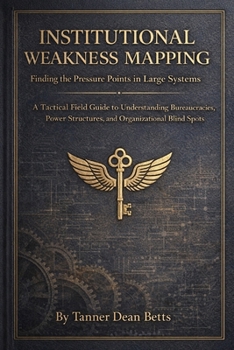
Institutional Weakness Mapping: A Tactical Field Guide to Understanding Bureaucracies, Power Structures, and Organizational Blind Spots

Large institutions appear powerful.
Governments, corporations, regulatory bodies, universities, and global organizations often project an image of control and precision. Layers of policy, procedure, and hierarchy give the impression of systems that operate smoothly and deliberately.
But beneath the surface, every large system contains structural weaknesses.
Information slows.
Decisions bottleneck.
Incentives drift away from mission.
Departments lose sight of the whole machine.
Over time, these small fractures accumulate pressure.
Most people experience the results as frustration-delays, confusion, bureaucratic obstacles. But for those who understand how institutions actually function, these moments reveal something far more valuable:
The hidden pressure points inside large systems.
Institutional Weakness Mapping is a tactical guide to understanding the architecture of complex organizations. Drawing on systems thinking, organizational behavior, and strategic analysis, this book reveals how large institutions really operate beneath their official structure.
Inside you will learn:
- Why large systems become fragile over time
- How information bottlenecks distort leadership decisions
- Where incentives quietly reshape institutional behavior
- How communication breakdowns create systemic blind spots
- Why crises often grow from small, unnoticed signals
- How to identify structural pressure points inside complex organizations
- How individuals can navigate bureaucratic systems more effectively
Written with clarity, insight, and a subtle sense of humor about the realities of bureaucracy, Institutional Weakness Mapping offers a rare look at the mechanics behind the institutions that shape modern life.
Once you understand the machine, you begin to see it everywhere.
And once you can see it, you can navigate it.
-or improve it.
Customer Reviews
ThriftBooks ® and the ThriftBooks ® logo are registered trademarks of Thrift Books Global, LLC
