


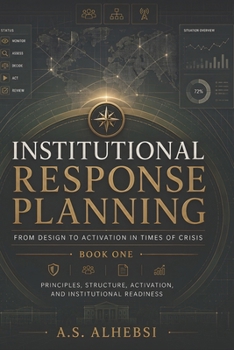
Institutional Response Planning: From Design to Activation in Times of Crisis

Crises do not wait for organizations to become ready. They arrive with pressure, uncertainty, incomplete information, urgent decisions, operational disruption, and real consequences.
Institutional Response Planning: From Design to Activation in Times of Crisis - Book One is a practical professional guide to building institutional response plans that are clear, usable, structured, and ready for activation when time is limited and decisions matter.
This first book focuses on the principles, structures, and operational thinking behind institutional response planning. It explains why response plans fail, how organizations can turn risks into practical scenarios, how to identify critical operations, how to build response teams, how to define authority, and how to activate and escalate response levels during incidents, emergencies, disruptions, and crises.
Inside this book, readers will learn how to:
Understand the real purpose of institutional response planningAvoid common reasons response plans failTurn risks into practical crisis scenariosIdentify critical operations and dependenciesBuild response teams with clear roles and responsibilitiesEstablish command and control structuresDefine activation and escalation levelsCommunicate during uncertainty and pressureManage the first five minutes, first thirty minutes, first two hours, and first twenty-four hoursDocument decisions, actions, and situation updatesConduct exercises, testing, and post-incident reviewsKeep the plan alive through governance, ownership, review, and continuous improvementBuild a culture of preparedness across the organizationWritten for professionals in security, safety, risk management, crisis management, business continuity, operations, compliance, facilities, communications, emergency planning, and leadership, this book provides a structured and practical approach to institutional readiness.
A strong response plan does not remove uncertainty, but it reduces confusion. It does not make difficult decisions easy, but it makes responsibility clearer. It does not prevent every disruption, but it helps organizations respond with discipline, care, and control.
This is a book for organizations that do not want their response plan to remain silent in a folder.
It is a book about turning planning into capability.
Customer Reviews
ThriftBooks ® and the ThriftBooks ® logo are registered trademarks of Thrift Books Global, LLC
