


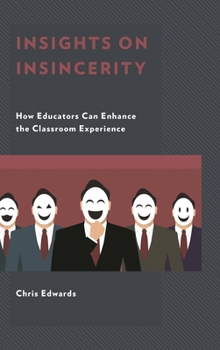
Insights on Insincerity: How Educators Can Enhance the Classroom Experience
No Customer Reviews

Select Format
Select Condition 
Book Overview
Erasmus praised folly and the Romantics waxed poetically about love, but no one until now has traced the history and impact of insincerity on society and the humanities. Insincerity arises when someone feels one way but acts another and an insincere situation looks to have one purpose but really hides another. Insincerity finds expression in four types of relationships: 1. From authority to the subordinate, 2. From the subordinate to authority, 3. Between equals 4. In society and in the self. Educators can discover how highlight insincerity in literature, history, psychology, sociology, politics, and popular culture. All readers can learn how to identify insincerity in their everyday relationships. Was that meeting at work really about conveying information and soliciting responses, or was it really about reinforcing the corporate hierarchy? When Galileo apologized to the Inquisition for positing a "solar" system, did he bring an end to an era of great religious sincerity? What did George Orwell get so wrong about insincerity in 1984? Most importantly, readers can find out what they should do when they you encounter that modern phrase that manifests insincerity: Thanks so much for your feedback.
Format:Paperback
Language:English
ISBN:1475841728
ISBN13:9781475841725
Release Date:March 2018
Publisher:Rowman & Littlefield Publishers
Length:128 Pages
Weight:0.44 lbs.
Dimensions:0.3" x 6.0" x 9.0"
Customer Reviews
0 rating
Copyright © 2026 Thriftbooks.com Terms of Use
| Privacy Policy | Do Not
Sell/Share My Personal Information | Cookie Policy | Cookie Preferences | Accessibility Statement
ThriftBooks® and the ThriftBooks® logo are registered trademarks of Thrift Books Global, LLC
ThriftBooks® and the ThriftBooks® logo are registered trademarks of Thrift Books Global, LLC
