


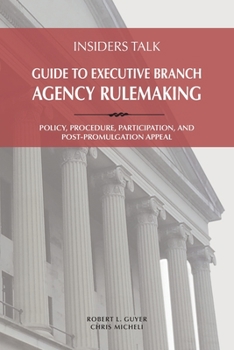
Insiders Talk Guide to Executive Branch Agency Rulemaking: Policy, Procedure, Participation, and Post-Promulgation Appeal

This is a best practices manual for advocates attempting to influence lawmaking by executive branch agencies, that is, the adoption of rules and regulations enforceable on the public. This book rests on four foundations:
Through rulemaking what the legislature gave, an executive agency can take away, and what the legislature wouldn't give, an executive agency might. For example, using agency discretion an agency can promulgate rules that extend benefits to one group to the exclusion of another.
And, to support the administrative state, taxpayers invest billions of dollars per year to employ and equip millions of state government workers. Each state has from dozens to hundreds of regulatory agencies, departments, boards, and commissions that implement public policy and adopt
and enforce regulations using legislatively delegated authority. They are the modern administrative state.
In terms of money, staff numbers, reach, and authority the administrative state dwarfs the executive, legislative, and judicial branches combined. While the legislative, executive, and judicial branches pursuant to the federal and state constitutions are coequal, in functional reality, the disproportionate size, power, wealth, and reach of the administrative state are so substantial that, since the 1930s, the administrative state has been called "the headless fourth branch of government." The strategies, skills, and techniques provided by this manual equip practitioners to achieve for their principals the best regulatory environment possible from the administrative state.
Customer Reviews
ThriftBooks® and the ThriftBooks® logo are registered trademarks of Thrift Books Global, LLC
