


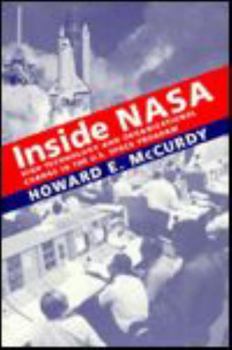
Inside NASA: High Technology and Organizational Change in the U.S. Space Program
(Part of the New Series in NASA History Series)

Select Format
Select Condition 
Book Overview
Revised
Format:Paperback
Language:English
ISBN:0801849756
ISBN13:9780801849756
Release Date:September 1994
Publisher:Johns Hopkins University Press
Length:232 Pages
Weight:0.77 lbs.
Dimensions:0.6" x 6.2" x 9.1"
Grade Range:Postsecondary and higher
Customer Reviews
1 rating
What was the Secret of NASA's Success with Apollo, and What Happened to It in the Decades Since the
Published by Thriftbooks.com User , 20 years ago
Howard E. McCurdy, Professor of Public Affairs at the American University in Washington, D.C., offers a significant response to that question. This study of NASA's organizational culture over the course of its entire history broke new ground in analyzing the manner in which a small, insular federal agency rose to accomplish the Apollo Moon landings at the end of the 1960s and early 1970s, as well as its devolution since that time. McCurdy covers such topics as the rise of the NASA technical culture, the Apollo fire, the success of the landings, the Apollo 13 near-disaster, the lunar orbit rendezvous, approaches to contracting, the relationships between NASA's centers and the headquarters, and much more. He attributes NASA's success during the Apollo period to a number of factors including extensive testing, technical capabilities maintained within the agency, and a willingness to accept risk and failure. Then he shows how with age, the agency's performance tended to decline. This is an important and provocative study with which, naturally, not everyone will agree. This work takes as its core mission the identification and tracing of the evolution of the organizational culture of NASA from its founding and expansion during the Apollo era through the changes in the 1970s and 1980s. Although sponsored by NASA, this book is far from being court history. It analyzes the reasons for what the author calls the "decline of NASA's technical culture" in the post-Apollo era, shedding new light on the agency's overall difficulties in recent years. Because of the book's provocative thesis and use by NASA management as a means of better understanding the agency, it received the Henry Adams Prize awarded by the Society for History in the Federal Government for the best interpretive history sponsored by a federal agency. In addition, since the publication of "Inside NASA" McCurdy has been asked to testify numerous times before various congressional committees concerned with NASA oversight about the agency's organizational culture and his expertise has been tapped by the agency to help reform its bureaucracy. This was especially true in the aftermath of the "Columbia" accident in 2003 when McCurdy served as a consultant to the Columbia Accident Investigation Board (CAIB). His expertise in organizational culture was present throughout the report as the CAIB found considerable fault with the agency's approach to doing business ensconced in its institutional culture. In the interest of full disclosure, I should add that Howard McCurdy and I are close friends and we have worked together on several historical projects over the years. I do not believe my friendship with him, however, changes the assessment of this important book, one which has found a central place in the historiography of NASA and spaceflight since its publication more than a decade ago.
Copyright © 2026 Thriftbooks.com
Terms of Use | Privacy Policy | Do Not Sell/Share My Personal Information | Cookie Policy | Cookie Preferences | Accessibility Statement
ThriftBooks ® and the ThriftBooks ® logo are registered trademarks of Thrift Books Global, LLC
ThriftBooks ® and the ThriftBooks ® logo are registered trademarks of Thrift Books Global, LLC
