


Insects: Biggest! Littlest!


Select Format
Select Condition 
Book Overview
Here are twenty-one sex-legged wonders from around the world--from the 22-inch-long Giant Stick Insect of Borneo to North America's Western Pygmy Blue Butterfly, with a wingspan of just a half inch.... This description may be from another edition of this product.
Format:Hardcover
Language:English
ISBN:1590785126
ISBN13:9781590785126
Release Date:March 2009
Publisher:Boyds Mills Press
Length:32 Pages
Weight:0.80 lbs.
Dimensions:8.3" x 0.5" x 10.3"
Age Range:5 to 7 years
Grade Range:Kindergarten to Grade 2
Related Subjects
Animals Bugs & Spiders Children's Children's Books Science, Nature & How It Works ZoologyCustomer Reviews
2 ratings
Beautiful bugs
Published by Thriftbooks.com User , 17 years ago
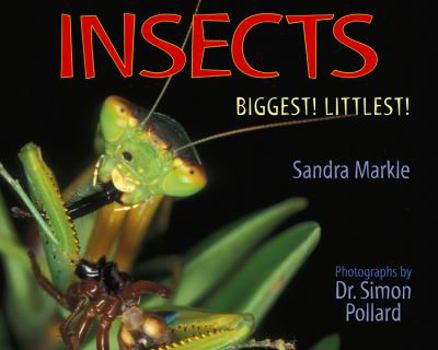
The cover of this book will grab you as surely that giant green praying mantis has grabbed the hapless spider it's eagerly shoving into it's maw. Inside, fairly simple text suitable for 2nd or 3rd grade readers details the lives of insects of various sizes. Science terms and jargon are given parenthetical phonetic spellings to help readers sound out their pronuciation. The photographs by Dr. Simon Pollard are truly the star attraction of this book. The full-color close-up photos on each page are absolutely gorgeous. The difference in scale is shown to best advantage in photos where other items are also pictured for reference. For example, the nearly 2 ft. long Giant Stick Insect of Borneo is shown climbing a tree, dwarfing the nearby man's hand. Also stunning is the photograph of the huge stag beetle on the final page, equal-sized to the human thumb it's firmly perched on. The Minute Pirate Bug, on the other hand, is simply shown sitting on a leaf. While we're told it's under an eighth of an inch long, it's difficult to judge the size based on the close-up photo. The Raja Brooke Birdwing butterfly and the Western Pygmy Blue butterfly shown on successive pages appear on nearly the same scale, and it's only through the text that we know the former is nearly a foot across, the latter, merely half-an-inch. The one feature that would have made this book better for me, I would have loved, loved, loved an appendum with silhouettes displaying the subjects relative size, and unfortunately, there wasn't one. There is however, a world map indicating all the various bugs native habitats, as well as a selected bibliography and a few websites. Teachers and school librarians who are looking to freshen up their non-fiction shelves could do worse than this visually appealing photograhic journey. For kids who like bugs this book is sure to be a hit.
Review from www.firrkids.com
Published by Thriftbooks.com User , 17 years ago
Now that the weather is warming up here in Michigan, we can get outside and inspect the wildlife. With young children, "wildlife" to us primarily means insects. The newest in the Sandra Markle Biggest! Littest! series is our new favorite insightful guide to aphids, butterflies, weevils, dragonflies, moths and more. I have never been much of a non-fiction reader myself, but seeing my children soak up this information in an amazing fashion makes me a convert. It's astounding to me how intently they listen, their brains absorbing each tiny detail, tucking away the facts, only to regurgitate them at some later date. And oh, the details given here! Like the title implies, this book affords us a close look at some of the biggest and smallest insects on Earth. Twenty different insects of all shapes and sizes are showcased. They range greatly in size from the Minute Pirate Bug at 2 millimeters, up to the Giant Stick Insect, which can grow to be 22 inches. Why the size variance? Simply put, some bugs need to be big and some fare better with smaller bodies. The Raja Brooke Birdwing Butterfly pictured below has a wing span of nearly a foot. Scientists believe the big wings help mates find each other. On the flip side, small stature works for the Western Pygmy Blue Butterfly, who at 1/2 inch wide are less likely to be seen by predators. Readers learn about how smaller sized insects can team up to form a larger. more powerful group, such as Carpenter Ants and Honeybees. We get a detailed description of how insects grow larger via life stages, and a great explanation on molting. This is a wonderfully informative, fascinating book for any child interested in the business of insects. Dr. Simon Pollard does his part by providing amazing photos - a great show of color and tiny details.
Copyright © 2026 Thriftbooks.com
Terms of Use | Privacy Policy | Do Not Sell/Share My Personal Information | Cookie Policy | Cookie Preferences | Accessibility Statement
ThriftBooks ® and the ThriftBooks ® logo are registered trademarks of Thrift Books Global, LLC
ThriftBooks ® and the ThriftBooks ® logo are registered trademarks of Thrift Books Global, LLC
