


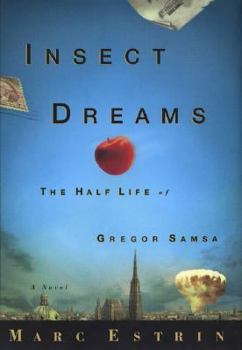
Insect Dreams: The Half Life of Gregor Samsa

Select Format
Select Condition 
Book Overview
It seems the Samsas' chambermaid only claimed to sweep into the dustbin the twentieth century's most remarkable contemplative. Instead, having spirited him from his bedchamber, she apparently sold the metamorphosed Gregor to a Viennese sideshow, where-it being 1915-he could earn his living lecturing carnival crowds on the implications of Rilke and Herr Spengler. In this delightfully original work of imagination, compassion, and good reason, we follow the trajectory of Kafka's salesman-turned-cockroach across two continents and thirty years as he touches the most significant flash points of his time. In the process, Marc Estrin delivers a human saga of cultural ambition and compassionate insight that may be the most surprising addition to Jewish literature in a generation. What's more, the book is funny. And Estrin's Gregor is downright endearing. With its reach and substance, Insect Dreams is nothing short of a liberal education-in cultural history, musical theory, nuclear physics, and the world of ideas. But it's also a remarkable reading experience. With a scope, heart, and intelligence unparalleled in recent memory, Insect Dreams should spark wide-ranging discussions about who we're becoming, now that the swiftest century is complete.
Format:Hardcover
Language:English
ISBN:0399148361
ISBN13:9780399148361
Release Date:February 2002
Publisher:Blue Hen
Length:480 Pages
Weight:1.75 lbs.
Dimensions:9.5" x 1.5" x 6.5"
Age Range:14 years and up
Grade Range:Grade 8
Customer Reviews
5 ratings
astonishing book
Published by Thriftbooks.com User , 23 years ago
Insect Dreams is a great achievement. The language is precise, rich and resonant, the range of characters vast, the intellectual and emotional content constantly challenging, the story fascinating. Couldn't put it down.
A comic masterpiece impressive for its erudition
Published by Thriftbooks.com User , 23 years ago
"Insect Dreams" begins with the assassination of Archduke Ferdinand and ends three decades later with the explosion at Los Alamos of the world's first atomic bomb; its 450 pages presents many of the era's major events and personalities as seen through the eyes of--well, a cockroach. But not just any cockroach. Gregor Samsa is the mistaken-for-dead human-turned-insect who made his debut in Franz Kakfa's "Metamorphosis." In this "sequel," Samsa is rescued by a freak show in Austria, where he teaches philosophy and physics to the masses and eventually meets Musil and Wittgenstein. He emigrates to America and becomes an exhibit at the Scopes Trial and a key player in the Roosevelt administration. Any plot summary (including mine) will necessarily make the book sound positively silly, but Estrin somehow pulls it off--again and again. As a New York Times reviewer noted in an enthusiastic essay, it's "Ragtime for roaches," but accurate as this phrase is, it disguises the fact that "Insect Dreams" is one of the most intelligent, witty, and fascinating novels ever written, with passages that should both delight and haunt any reader. The most enviable aspect of Estrin's debut--and it's hard to believe that this is his first novel--is that it manages to frame an extraordinarily satisfying intellectual feast with a page-turning plot that is both hilarious and moving. Encapsulating what was arguably the worst thirty years in human history, yet featuring some of the most brilliant minds ever produced by civilization, this literary masterpiece will appeal to both brainiacs and beach-readers.
A Wonderful Book!!!!!
Published by Thriftbooks.com User , 23 years ago
INSECT DREAMS is an allegory following in the footsteps of THE PILGRIM'S PROGRESS, GULLIVER'S TRAVELS and CANDIDE. Gregor, metamorphosed into a man-sized roach, canters picaresquely through some of the key historical events of the first half of the Twentieth Century as if they were real. The bug's conversations with Ludwig Wittgenstein, Charles Ives, Albert Einstein, Leo Szilard, FDR, Richard Feynman and J. Robert Oppenheimer-to name only a few-are unbelievably comic as well as profoundly sad. The concept of a roach contributing the vital ingredients to several of the social programs and inventions that make up our "World of Tomorrow" is darkly funny, something like a Jewish joke told in the Warsaw Ghetto. His being bug-brown, Jewish, smart, bearing a chronic open wound inflicted by his father as well as belonging to the insect Order Orthoptera, Family Blattidae (cockroaches), creatures almost universally detested, would indeed seem to be a loaded symbolic trope if Estrin hadn't made his hero so loveable. Estrin's prose is both forceful and graceful. His intelligence is enormous, encompassing biology and medicine, music, literature and of course manners, politics and history. Estrin's sensitivity is deeply moving: he has succeeded wonderfully in extending the life of Franz Kafka's most familiar creature.
Estrin did it. He made me love a roach.
Published by Thriftbooks.com User , 23 years ago
When an imaginative and gifted author can use a giant roach as his main character, include a romance between the roach and a human, and still make you love him, he's accomplished a colossal feat. Yet these are only a few of Estrin's marvelous achievements in this thoughtful, but very playful, and often very funny chronicle of western history and thought from World War I through the dropping of the atomic bomb in World War II. Gregor Samsa, the famous salesman turned roach in Kafka's Metamorphosis, ends up not in Kafka's dustbin, but as part of a Viennese freak show run by Amadeus Hoffnung, in the opening chapter, "Tails of Hoffnung." Reciting Rilke and discoursing on Spengler's Decline of the West, Gregor attracts the attention of writer Robert Musil, who tells him that although western humanity is finished, that "Society...is in a larval state. What it needs is a larval model to lead it onward, upward, and out of the corral," and Gregor is that larval model, his ironic task being to teach us what it means to be human. In lighthearted, fast-paced prose, Estrin describes Gregor's emigration to New York, his search for identity, and his eventual connection to seminal events in western history and the people responsible for them. The music of Charles Ives, the Scopes trial (at which Gregor, ironically, testifies), the executions of Sacco and Vanzetti, the election and administration of FDR, and the development of the atomic bomb are just a few of Estrin's sensitively presented turning points of American history. At Eleanor Roosevelt's urging, Gregor accepts the offer to move into the White House, where he lives, literally, as part of the "kitchen cabinet" and works at the Department of Agriculture as an exterminator. Extermination and the death of "others" are, in fact, strong themes throughout this novel, despite its playfulness, and an increasing gravity and darkness develop as the plot progresses. As Gregor, the king of otherness, shows us, the U.S., historically, has not been immune to prejudice, and he is remarkably critical of FDR for failing to take an early stand against the Holocaust when clear evidence was available to him. Still, this powerful book ends on a positive note, one which readers of this extraordinary tale will long remember--and, I suspect, share with their friends. Mary Whipple
A tour de force, as moving as it is ambitious
Published by Thriftbooks.com User , 24 years ago
There's been a lot of "industry buzz" about this one, so I was both looking forward to reading it and dreading it--such is the nature of "industry buzz." But INSECT DREAMS is the real thing, a literary and imaginative tour de force that somehow manages to be both highbrow in the tremendous breadth and depth of its knowledge of history, music, science and philosophy, and unpretentious (unlike, say, "The Corrections," which I found brilliant, yes, but thought suffered from a far greater affection towards itself than towards its characters). INSECT DREAMS is also a terrific, page-turning read. Perhaps Marc Estrin succeeds so admirably in this difficult balance because (it seems clear)he is writing from a place of moral and visceral urgency. And yet his is an urgency tempered by patience; a rare combination that--judging from the author photo--says something for writing one's first novel in middle age. But forget about age, Estrin is simply a writer writing for the best possible reason: because he has something to say. Whether or not one agrees with his "message" it is exhilirating to find oneself lost in the exquisite humor, pathos and intellectual acumen that define this memorable novel.
Copyright © 2026 Thriftbooks.com Terms of Use
| Privacy Policy | Do Not
Sell/Share My Personal Information | Cookie Policy | Cookie Preferences | Accessibility Statement
ThriftBooks® and the ThriftBooks® logo are registered trademarks of Thrift Books Global, LLC
ThriftBooks® and the ThriftBooks® logo are registered trademarks of Thrift Books Global, LLC
