


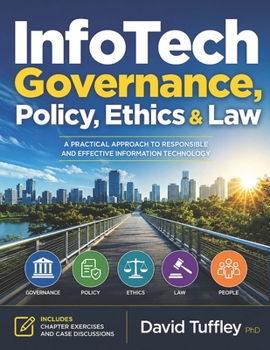
InfoTech Governance, Policy, Ethics & Law
No Customer Reviews

Introducing: "InfoTech Governance, Policy, Ethics & Law" by Dr. David Tuffley
Technology runs your organisation. Who governs the technology? It is one of the most consequential questions in contemporary business and public life, yet it is asked far less often than it should be. Every organisation that relies on digital infrastructure - which is to say every organisation - is exposed to a web of governance obligations, regulatory requirements, ethical dilemmas, and security threats that grow more complex with each passing year. InfoTech Governance, Policy, Ethics & Law is the authoritative, comprehensive guide for IT professionals, managers, and students who need to understand this terrain and navigate it with confidence.This textbook is a comprehensive guide to IT governance, policy, ethics and law for students, practitioners and researchers. It covers the latest developments and best practices in the field, with a focus on the ethical, legal and social implications of IT. The textbook is divided into nine chapters, each covering a key topic in IT governance, policy, ethics and law. The chapters are:
Chapter 1: IT Governance Frameworks. This chapter introduces the concept and importance of IT governance, and reviews the main frameworks and standards for IT compliance and data retention. Chapter 2: Cybersecurity and Data Protection. This chapter explores the challenges and opportunities of cybersecurity and data protection in the digital age, and discusses the international and national regulations and guidelines for privacy, data transfers, data breach notification, AI accountability and ethical hacking. Chapter 3: Cloud Computing and Outsourcing. This chapter examines the benefits and risks of cloud computing and outsourcing, and explains the contractual and legal issues involved in these arrangements. Chapter 4: Digital Ethics and Responsible AI. This chapter analyzes the ethical principles and values that should guide the design, development and use of digital technologies and AI, and addresses the topics of algorithm bias, emerging technologies, whistleblower protection and AI art. Chapter 5: Intellectual Property and Copyright. This chapter explains the basic concepts and types of intellectual property rights, and explores the challenges and solutions for digital rights management, open-source software licensing and fair use. Chapter 6: E-Gov and Digital Transformation. This chapter describes the role and impact of IT in government and public administration, and highlights the best practices and case studies of e-government, citizen engagement, smart cities and remote work. Chapter 7: Impact of IT on Society. This chapter assesses the positive and negative effects of IT on society, culture and human behavior, and covers the topics of social media, technology for social good, accessibility and inclusion. Chapter 8: Employee IT Usage and Policies. This chapter discusses the rights and responsibilities of employees and employers regarding IT usage in the workplace, and provides guidance on how to create effective IT policies that balance privacy, security and productivity. Chapter 9: IoT Security and Privacy. This chapter explores the security and privacy issues related to the Internet of Things (IoT), and covers the topics of IoT ethics, biometric data usage, data localization and sovereignty. The textbook is written in plain English to make it accessible to a wide audience, without compromising on accuracy or rigor. It also includes learning objectives, key terms, review questions, case studies, exercises and references at the end of each chapter to enhance the learning experience.Format:Paperback
Language:English
ISBN:B0CJ44YHVL
ISBN13:9798858323341
Release Date:September 2023
Publisher:Independently Published
Length:350 Pages
Weight:1.79 lbs.
Dimensions:0.7" x 8.5" x 11.0"
Customer Reviews
0 rating
Copyright © 2026 Thriftbooks.com
Terms of Use | Privacy Policy | Do Not Sell/Share My Personal Information | Cookie Policy | Cookie Preferences | Accessibility Statement
ThriftBooks ® and the ThriftBooks ® logo are registered trademarks of Thrift Books Global, LLC
ThriftBooks ® and the ThriftBooks ® logo are registered trademarks of Thrift Books Global, LLC
