


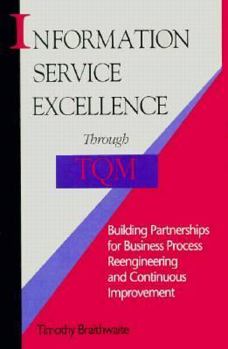
Information Service Excellence Through Tqm: Building Partnerships for Business Process Reengineering and Continuous Improvement


This book presents an application of total quality management (TQM) principles, tools, and techniques to the business of defining, constructing, and delivering automated information systems and... This description may be from another edition of this product.
Format:Hardcover
Language:English
ISBN:0873892712
ISBN13:9780873892711
Release Date:January 1994
Publisher:Asq Pr
Length:145 Pages
Weight:1.15 lbs.
Dimensions:9.3" x 0.5" x 6.3"
Customer Reviews
1 rating
Valuable for orgs that do heavy development
Published by Thriftbooks.com User , 24 years ago
After reading the author's "The Power of IT: Maximizing Your Technology Investments" I was sufficiently impressed with his work to track down other books that he had written. This book starts with a 360 degree view of IS by giving the following viewpoints and perceptions: users, bottom line, and from within IS itself. Although this book was written in 1994 it is as valid today as when Mr. Braithwaite wrote chapter 1. The next chapter is a discussion of TQM, and its main value is to synchronize the author's definitions with our own. A few topics here were real gems, including managing by prevention, identifying and measuring the cost of quality, and measuring the performance of business processes which IS is chartered to support. The best part of this chapter the structure and approach for institutionalizing management of change. Mr. Braithwaite proposes four different groups: (1) management, (2) measurement, (3) education and (4) employee involvement committees. This approach does ensure that all major stakeholders are involved, and it also will prevent IT/IS from operating in a vacuum. Chapter 3 is devoted to TQM within IS, but the focus moves to systems development. I was hoping for a more holistic treatment of IS that also covered service delivery and support, and production. These areas are covered, but only within the context of systems development. The next three chapters are devoted to incorporating TQM into the systems development process. Chapter 4 is devoted to establishing TQM, chapter 5 covers TQM initiatives in the requirements definition phase, and chapter 6 addresses TQM in the build and delivery phases. Chapter 6 has some excellent information on metrics, testing and release to production. I especially liked chapter 7, which focuses on creating a quality culture within IS. Some of the factors and indicators that Mr. Braithwaite provides in this chapter are worth reading carefully, including staff turnover and the effect on cost of quality, and the TQM implementation model for IS. I also liked the way the author aligns seven of Deming's principles to IS department management. This is another area that is worth reading.Chapter 8 wraps up this 141 page book with a discussion of future directions for IS within the context of TQM. Some of the key points here include: change perceptions [of users and the business] through performance, add value to the enterprise, and formulate a long-term vision. These points should be mandates for any IS department regardless of whether they elect to implement TQM or not. Overall this is a valuable book if your organization does heavy development. If your development is limited to light maintenance programming or adding features to an enterprise resource planning application, much of this book will not apply. If you are in the first group or you want to learn about how TQM can be applied to development, you will find this to be a 4-star book that is worth tracking down.
Copyright © 2026 Thriftbooks.com Terms of Use
| Privacy Policy | Do Not
Sell/Share My Personal Information | Cookie Policy | Cookie Preferences | Accessibility Statement
ThriftBooks® and the ThriftBooks® logo are registered trademarks of Thrift Books Global, LLC
ThriftBooks® and the ThriftBooks® logo are registered trademarks of Thrift Books Global, LLC
