


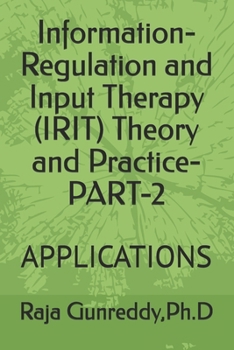
Information-Regulation and Input Therapy (IRIT) Theory and Practice-PART-2: Applications

Information-Regulation and Input Therapy (IRIT): Theory and Practice - Part II: Applications is not a book about fixing people. It is a book about finally understanding what people are being exposed to-and how that exposure quietly shapes their emotions, relationships, and sense of self long before conscious choice enters the room.
Most readers arrive here carrying an unspoken fatigue. A fatigue that doesn't come from effort, but from saturation. From being constantly informed, advised, stimulated, compared, evaluated, and emotionally pulled by forces they did not choose. This book begins by honoring that exhaustion-not as weakness, but as a rational response to an environment that never stops speaking to the mind.
Part II moves IRIT out of theory and into lived reality. It sits beside the reader in everyday spaces: the family conversation that leaves a heaviness afterward, the phone screen that promises relief but delivers agitation, the workplace where performance metrics slowly replace meaning, the relationship where love exists but emotional regulation does not. Instead of asking "What is wrong with you?", this book asks a gentler and more accurate question: "What inputs are shaping you right now?"
The emotional core of this volume lies in its reframing of distress. Anxiety is no longer treated as an internal flaw. Emotional numbness is no longer seen as apathy. Overthinking is no longer framed as lack of discipline. Each is approached as an outcome of unmanaged informational flow-too much, too fast, too emotionally charged, too poorly filtered. This shift alone brings relief. Readers often recognize themselves on these pages, not as broken individuals, but as minds doing their best under relentless conditions.
What makes this book intimate is its respect for human dignity. The applications of IRIT are not prescriptive or punitive. They do not demand detoxes, withdrawal from society, or unrealistic control over life. Instead, they offer something subtler and more humane: the possibility of regaining authorship. Small, deliberate changes in what is allowed in, how it is processed, and when it is paused. The reader is not asked to escape the modern world-but to learn how to stand inside it without losing themselves.
Clinicians will find practical frameworks that feel grounded rather than mechanical. Educators will see how attention, curiosity, and emotional safety can be restored without coercion. Couples and families will recognize how unregulated information-not lack of love-often drives distance and conflict. Individuals will feel something rare: permission to slow down without guilt.
Above all, this book speaks to a quiet hope-that mental health in the information age does not require harder thinking, but wiser regulation. That healing can begin not with changing who we are, but with caring for what continuously enters us. Part II of IRIT is an invitation to that care. A reminder that peace is not absent stimulation-but balanced input. And that clarity, once protected, gently returns.
Customer Reviews
ThriftBooks ® and the ThriftBooks ® logo are registered trademarks of Thrift Books Global, LLC
