


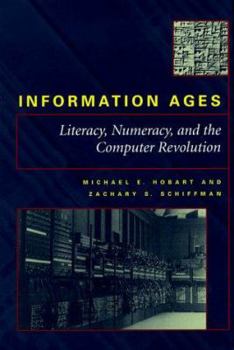
Information Ages: Literacy, Numeracy, and the Computer Revolution


Select Format
Select Condition 
Book Overview
The late twentieth century is trumpeted as the Information Age by pundits and politicians alike, and on the face of it, the claim requires no justification. But in Information Ages, Michael E. Hobart... This description may be from another edition of this product.
Format:Hardcover
Language:English
ISBN:080185881X
ISBN13:9780801858819
Release Date:September 1998
Publisher:The Johns Hopkins University Press
Length:320 Pages
Weight:1.40 lbs.
Dimensions:9.3" x 1.3" x 6.5"
Customer Reviews
1 rating
A novel history of information
Published by Thriftbooks.com User , 16 years ago
Hobart and Schiffman have pioneered a new view of history, describing the inventions of literacy, numeracy and mechanical computation as distinguishing three eras of human achievement. They present their evidence clearly, and I finished the book feeling that I had gained a better understanding of civilization, as well as of the evolution of mathematics (which is of particular interest to me). The closing chapter is an enjoyable glimpse into the future, in which the authors conjecture that cellular automata (such as those described in Wolfram's controversial A New Kind of Science) may be the next turning point. Still, this book is often frustrating. One particularly galling thing is the authors' stubborn refusal to define the word "information," allowing them to use it however they like, making various non-falsifiable claims. For instance, the authors assert at one point that before the invention of writing, there was no such thing as information. Later, they say that the analytic methods devised by René Descartes were a "new way of informing." What do they mean by this? It's unclear. Had the authors better defined their terminology, this book would have been both an easier and a more enlightening read. Instead, I recommend it with reservations: Information Ages is a challenge, but will reward those who persist.
Copyright © 2026 Thriftbooks.com Terms of Use
| Privacy Policy | Do Not
Sell/Share My Personal Information | Cookie Policy | Cookie Preferences | Accessibility Statement
ThriftBooks® and the ThriftBooks® logo are registered trademarks of Thrift Books Global, LLC
ThriftBooks® and the ThriftBooks® logo are registered trademarks of Thrift Books Global, LLC
