


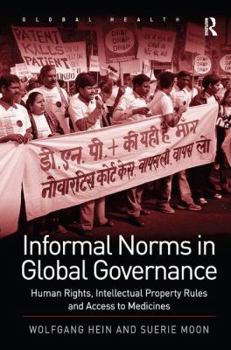
Informal Norms in Global Governance: Human Rights, Intellectual Property Rules and Access to Medicines
No Customer Reviews

Select Format
Select Condition 
Book Overview
Hein and Moon take up a serious problem of contemporary global governance: what can be done when international trade rules prevent the realization of basic human rights? Starting in the 1990s, intellectual property obligations in trade agreements required many developing countries to begin granting medicines patents, which often rendered lifesaving drugs unaffordable. At stake was the question of what priority would be given to health-particularly of some of the world's poorest people-and what priority to economic interests, particularly those of the most powerful states and firms. This book recounts the remarkable story of the access to medicines movement. The authors offer an explanation for how the informal, but powerful norm that every person should have access to essential medicines emerged after a decade of heated political contestation and against long odds. They also explore the stability and scope of the norm. Finally, the book examines the limitations of informal norms for protecting human rights, and when renewed focus on changing formal norms is warranted.
Format:Hardcover
Language:English
ISBN:1409426335
ISBN13:9781409426332
Release Date:February 2013
Publisher:Routledge
Length:260 Pages
Weight:1.20 lbs.
Dimensions:0.6" x 6.1" x 9.2"
Customer Reviews
0 rating
Copyright © 2025 Thriftbooks.com
Terms of Use | Privacy Policy | Do Not Sell/Share My Personal Information | Cookie Policy | Cookie Preferences | Accessibility Statement
ThriftBooks ® and the ThriftBooks ® logo are registered trademarks of Thrift Books Global, LLC
ThriftBooks ® and the ThriftBooks ® logo are registered trademarks of Thrift Books Global, LLC
