


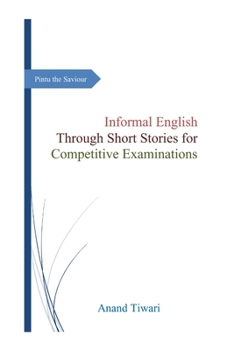
Informal English Through Short Stories for Competitive Examinations: Pintu the Saviour
No Customer Reviews

Why This Book?The two most common solution suggested by wise and learned mass to improve vocabulary, mainly informal, are: a.Read stories and novels.b.Use a dictionary.This, usually, leads to the following chain of events: a.A student buys a novel, suggested by a friend, teacher or guided by www.b.He flips through the pages. Musters some courage to read a few paragraphs, drops the novel in desperation. In short, he gives up.We could neither question the advice nor the effort. So, what went wrong? # Reading, like good or bad habit, require some effort to initiate# The dose must be low - to - high.# The suggested books are usually written by great authors who are difficult to decipher even by critics, for our student - fat chance.# These books do not contain a glossary at the end of each text. Going to a dictionary frequently, kills the charm of reading. Remember reading your school textbooks - difficult words can be referred to at the end of the chapter - in any case the teacher was always there.# These books do not tell you who is who - where is an idiom, a phrase, etc. If you do not know that a expression is idiomatic, how could you know it's hidden meaning?# The book does not ask you to practise.This book has been made keeping all this in min
Format:Paperback
Language:English
ISBN:1699238995
ISBN13:9781699238998
Release Date:October 2019
Publisher:Independently Published
Length:108 Pages
Weight:0.40 lbs.
Dimensions:0.3" x 5.5" x 8.5"
Customer Reviews
0 rating
Copyright © 2026 Thriftbooks.com Terms of Use
| Privacy Policy | Do Not
Sell/Share My Personal Information | Cookie Policy | Cookie Preferences | Accessibility Statement
ThriftBooks® and the ThriftBooks® logo are registered trademarks of Thrift Books Global, LLC
ThriftBooks® and the ThriftBooks® logo are registered trademarks of Thrift Books Global, LLC
