


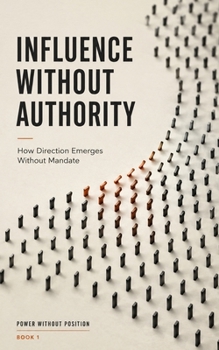
Influence Without Authority

HOW DIRECTION EMERGES WITHOUT MANDATE
Authority remains visible.
Influence begins to decide.
In many organizations, direction no longer follows mandate. Coordination happens before instruction, alignment forms without decision ownership, and people follow signals that are never formally issued. Roles remain intact, yet authority loses its capacity to bind.
Influence Without Authority examines how direction emerges when formal authority becomes structurally insufficient. The book does not treat influence as a leadership skill or interpersonal competence. It analyzes influence as a structural phenomenon that takes effect when decision rights, accountability, and mandate no longer align.
Across analytical chapters, case-based illustrations, and failure scenarios, the book shows how informal direction stabilizes organizational action while simultaneously detaching influence from responsibility. It makes visible why organizations rely on influence precisely when authority becomes ambiguous, distributed, or overloaded.
The focus is not on individuals, but on conditions. Influence appears where structure no longer absorbs uncertainty, where decisions exist without binding force, and where coordination must continue despite unresolved authority.
This book is written for readers working within complex organizations who want to understand why authority weakens without disappearing, and how direction continues to form without being formally assigned.
Customer Reviews
ThriftBooks ® and the ThriftBooks ® logo are registered trademarks of Thrift Books Global, LLC
