


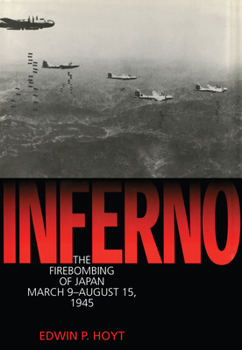
Inferno: The Firebombing of Japan, March 9-August 15,1945

Did the bombing of Japan's cities-culminating in the nuclear destruction of Hiroshima and Nagasaki-hasten the end of World War II? Edwin Hoyt, World War II scholar and author, argues against the U. S. justification of the bombing. In his new book, Inferno, Hoyt shows how the U. S. bombed without discrimination, hurting Japanese civilians far more than the Japanese military. Hoyt accuses Major General Curtis LeMay, the Air Force leader who helped plan the destruction of Dresden, of committing a war crime through his plan to burn Japan's major cities to the ground. The firebombing raids conducted by LeMay's squadrons caused far more death than the two atomic blasts. Throughout cities built largely from wood, incendiary bombs started raging fires that consumed houses and killed hundreds of thousands of men, women and children. The survivors of the raids recount their stories in Inferno, remembering their terror as they fled to shelter through burning cities, escaping smoke, panicked crowds, and collapsing buildings. Hoyt's descriptions of the widespread death and destruction of Japan depicts a war machine operating without restraint. Inferno offers a provocative look at what may have been America's most brutal policy during the years of World War II.
Format:Hardcover
Language:English
ISBN:1568331495
ISBN13:9781568331492
Release Date:October 2000
Publisher:Madison Books
Length:184 Pages
Weight:0.94 lbs.
Dimensions:0.8" x 6.1" x 9.3"
Customer Reviews
1 rating
A heartbreaking account of neglected history
Published by Thriftbooks.com User , 24 years ago
Most people are unaware that the firebombing campaign of Curtis LeMay killed more people - the vast majority of them civilian - than both of the atomic bombings combined. LeMay himself said that if his country did not win the war, he would be tried as a war criminal.Hoyt here alternates between accounts of the bombing missions, the evolution of their inciniary civilian bombing campaign, and the stories of families on the ground during the conflagration. He is in top form here, shedding a bright light on one of the darkest corners of the Pacific War, and it is both uncomfortable and unsettling. In particular, the chapter "Road to Hiroshima" will leave you with both a chill and a tear in your eye. The writing is clear and lucid, and eyewitness accounts are all cross-referenced. The book is short and will be read quickly, in just a day or two, but it is valuable for cross-referencing general histories in which the firebombing campaign is usually (shamefully) reduced to a single paragraph or less.You will leave this book with a bitter understanding of the distilled trajedy that was the Pacific War, of the unchecked destruction and wanton slaughter that became not only expected, but as some would argue, necessary. That such killing could ever become justified is the lesson that we non-veterans must not just learn but know. We must, as armchair historians, allow ourselves to see the practices and results of our great nation's military, so that we might learn from them and absorb whatever lessons we can from the honor and courage of the men who fought there... and, bitterly, the women and children who died there. We owe it to the participants as well as both of our countries as well as the generations of future children to preserve the stories of our victories, however phyrric they might be.Edwin Hoyt has done a superb job of communicating these thoughts. If you have an interest in the Pacific War, this is recommended reading. Its a hardcover as well, so it makes a nice addition to your library. Thank you, Mr. Hoyt.
Copyright © 2026 Thriftbooks.com
Terms of Use | Privacy Policy | Do Not Sell/Share My Personal Information | Cookie Policy | Cookie Preferences | Accessibility Statement
ThriftBooks ® and the ThriftBooks ® logo are registered trademarks of Thrift Books Global, LLC
ThriftBooks ® and the ThriftBooks ® logo are registered trademarks of Thrift Books Global, LLC
