


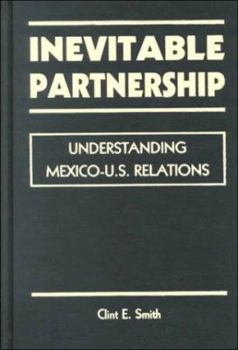
Inevitable Partnership: Understanding Mexico-U.S. Relations


This volume describes the complex Mexico-US relationship from the beginning of the 19th century through to the end of the 20th century. Chapters explore the evolution of the relationship covering... This description may be from another edition of this product.
Format:Paperback
Language:English
ISBN:1555878733
ISBN13:9781555878733
Release Date:April 2000
Publisher:Lynne Rienner Pub
Length:241 Pages
Weight:0.70 lbs.
Dimensions:9.0" x 0.5" x 6.0"
Customer Reviews
2 ratings
Perfect Tining: Inevitable Partnership
Published by Thriftbooks.com User , 25 years ago
This an excellent book and the timing is perfect to read it NOW, given the advent of a new Administration in Mexico and the up-coming US electoral campaign.Dr. Smith briefly and concisely reviews the history of US-Mexican relations, providing a well-documented and objective background for understanding how we have dealt with US-Mexican relations historically and have arrived at today's relationship. He convincingly makes the argument that our bilateral relationship is probably the most important one the US has, given the myriad of economic, political, geographical, social, and cultural factors which tie us together.In addition, Smith catalogues and describes the most important bilateral issues which we face together. He discusses the economic/trade/financial topics of which the NAFTA is only one; the environmental question, which is so important given the 2000 mile cross-polluitng border; the drug-trafficking and other criminal issues which we damage our societies; the immigration and labor issues which bring potential advantages and disadvantages to both countries; the Mexican political and human rights situation which affects US policy-making; and a host of other bilateral problems. These problems have been with us for decades and will not be solved quickly, if ever, but they must be faced.The above background provides the most important reason for reading and digesting Smith's book. It provides us with the factual and backgound data which will be required as we attempt to understand and analyze the election victory of Vicente Fox and his future policies. Basically, the book can be used as a primer for watching Mexico over the next year, as well as understanding the US response to Fox policies and policy initiatives. As Smith so effectively points out, bilateral policy can not be implemented successfully without the input and action of both countries. Fox's policy initiatives will of course be based on the history and background of the most important bilateral isses. Another Smith insight is that there are few domestic policies in Mexico which are not somehow tied to US policies. The status of the US eocnomy is of course one of the most obvious one. This essential need for bilateral policy formulation and implementation more and more includes the role of US non-Federal Agencies (US States and Municipalities)such as the state of California. (In fact one of Fox's campaign promises is to de-centralized government in Mecico.) Smith includes a full chapter on California, which will be all-important to a successful US-Mexican relationship, given the state's huge economy and large Mexican-Ameican population. The background of immigration proposition 187 is only one of the issues covered by Dr. Smith.Also, California will be a key factor in the up-coming US Presidential election with millions of its voters concerned about policy on US-Mexican issues, especially business and trade, and immigration.
Analyzing a Relationship
Published by Thriftbooks.com User , 25 years ago
This upbeat yet nuanced overview, appearing on the eve of an interesting Mexican Presidential election, summarizes recent developments in U.S.-Mexican relations and outlines the most challenging aspects. Smith's intended audience is the diverse mix of business people, students, government officials and thoughtful travelers who are curious about our increasingly important, but often troubled, relationship with Mexico. Just over 200 pages in length the book fits easily in a briefcase or a backpack. Smith grew up in Las Cruces, New Mexico, was a Foreign Service Officer at the U.S. Embassy in Mexico in the 1970's, and is now a senior research associate at the Stanford Institute for Economic Policy Research at Stanford.A quick forty pages of historical background introduces the meat of the book, the last three decades years of our common history with Mexico leading up to in the North American Free Trade Agreement (NAFTA). As Smith makes clear NAFTA seems to have been a success from the trade perspective. U.S.- Mexican trade has increased in both directions from $100 billion in 1994, when NAFTA went into effect, to $175 billion in 1998. In the U.S. the economy has been strong and the huge shift of jobs to south of the border, which had been forecast by Ross Perot and others never happened.Meanwhile, during these same years the Mexican economy sagged and rebounded with only modest overall gains. The political scene has been unsettled and social order has deteriorated. The very day that NAFTA went into effect, armed Zapatista rebels seized six towns in Chiapas, Mexico's southernmost state. A few months later Luis Donaldo Colosio, the government party (PRI) candidate, who was advocating political reform, was assassinated. The replacement candidate Ernesto Zedillo was elected easily in a fair election, but shortly thereafter, the peso collapsed. Outgoing President Carlos Salinas, who had been campaigning with U.S. support to lead the World Trade Organization, fled Mexico surrounded by the stench of corruption. Meanwhile, Mexico has been plagued by an escalating crime wave. Drug trafficking, despite some strenuous efforts on both sides of the border, continues largely unabated. The rebels have been driven from the towns but still hide out in the mountains of Chiapas. The minimum wage in Mexico is $4 a day and a third of workers earn less. Emigration, either legal or illegal, to the US is an answer for some workers, the majority of whom find work in construction, household services or the restaurant industry. Although the newcomers often cause tension in communities which must house and provide public services for what seems like a flood of foreigners, on balance the immigration flow is a net plus to the U.S. economy.Smith, looking to NAFTA, greater freedom for private business and nascent changes in what has heretofore been a one-party political system, calls the change in Mexico profound. The reviewe
Copyright © 2026 Thriftbooks.com Terms of Use
| Privacy Policy | Do Not
Sell/Share My Personal Information | Cookie Policy | Cookie Preferences | Accessibility Statement
ThriftBooks® and the ThriftBooks® logo are registered trademarks of Thrift Books Global, LLC
ThriftBooks® and the ThriftBooks® logo are registered trademarks of Thrift Books Global, LLC
