


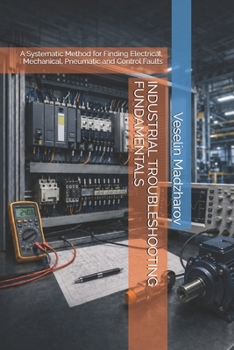
Industrial Troubleshooting Fundamentals: A Systematic Method for Finding Electrical, Mechanical, Pneumatic and Control Faults

A MACHINE HAS STOPPED. THE ALARM IS ACTIVE. PRODUCTION IS WAITING.
Where do you begin?
Industrial Troubleshooting Fundamentals provides a practical, systematic method for finding electrical, mechanical, pneumatic and control faults without relying on guesswork, random component replacement or unnecessary PLC program changes.
Modern industrial machines combine power circuits, sensors, relays, contactors, motors, pneumatic actuators, mechanical systems, safety devices and PLC logic. A fault in one discipline can easily appear to belong to another. A dragging mechanism may look like a motor problem. Low air pressure may appear to be a sensor failure. A loose electrical connection may create random PLC alarms. The visible symptom is rarely the complete explanation.
This book teaches you how to follow the machine's functional chain:
ENERGY → COMMAND → PERMISSION → ACTION → FEEDBACK
By identifying which function is missing and testing the conditions required for that function, you can locate the real fault faster, prove the root cause and verify that the repair is complete.
Inside this practical guide, you will learn how to:
- Separate symptoms, faults and root causes
- Use a repeatable nine-step troubleshooting method
- Divide complex machinery into manageable functional blocks
- Read electrical drawings without assuming they match the real machine
- Select measurements that eliminate possible causes
- Test voltage, continuity, resistance, current and industrial signals correctly
- Diagnose mechanical drag, wear, looseness, backlash and misalignment
- Find pneumatic pressure, flow, leakage and sequencing problems
- Prove complete sensor and actuator signal paths
- Troubleshoot relays, contactors, overloads and motor-control circuits
- Identify missing PLC permissions, interlocks and sequence conditions
- Capture intermittent, vibration-related and temperature-dependent faults
- Recognize cross-discipline failures and misleading symptoms
- Verify repairs and prevent the same breakdown from returning
The book includes realistic factory cases presented through a clear professional structure:
SYMPTOM → HYPOTHESES → TESTS → MEASUREMENTS → EVIDENCE → ROOT CAUSE → REPAIR → VERIFICATION → PREVENTION
Instead of presenting troubleshooting as a special talent, the book explains it as a disciplined process that can be learned, repeated and improved.
Realistic examples include machines that will not start, contactors that fail to energize, cylinders that stop before reaching position, motors that trip under load, sensors that appear unstable, PLC sequences that remain blocked and faults that disappear as soon as the cabinet door is opened.
You will also receive practical diagnostic worksheets, electrical and mechanical inspection checklists, pneumatic test guidance, troubleshooting-tool recommendations and a technical glossary for field use.
WHO THIS BOOK IS FOR
- Industrial electricians
- Maintenance and service technicians
- Mechanical maintenance personnel
- Automation and PLC technicians
- Electromechanical engineers
- Commissioning specialists
- Technical students and apprentices
- Maintenance supervisors and team leaders
Whether you are responding to your first machine breakdown or improving the diagnostic discipline of an experienced maintenance team, this book will help you replace assumptions with evidence and activity with controlled investigation.
Stop asking which component looks guilty.
Start asking which function is missing, where the chain is broken and what measurement will prove it.
Customer Reviews
ThriftBooks ® and the ThriftBooks ® logo are registered trademarks of Thrift Books Global, LLC
