


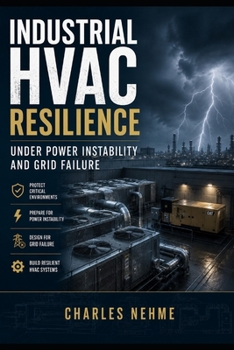
Industrial HVAC Resilience Under Power Instability and Grid Failure

Industrial HVAC systems are no longer operating in a stable and predictable electrical environment. The assumption that power is continuously available has become outdated in many regions, replaced by a reality where brownouts, micro-outages, voltage fluctuations, and full grid failures occur with increasing frequency.
In critical industrial environments-data centers, hospitals, semiconductor plants, pharmaceuticals, laboratories, and advanced manufacturing-these disturbances are not minor inconveniences. They are system-level threats that can lead to thermal runaway, process disruption, equipment damage, product loss, and in some cases, safety hazards.
This book was written to address a gap that is often overlooked in conventional HVAC literature: system behavior under electrical instability. While many texts focus on steady-state design, efficiency, and peak load calculations, very few explore what actually happens when the electrical foundation of the system becomes unreliable.
The objective here is practical and direct. This is not a theoretical discussion of resilience in abstract terms. It is a structured examination of real failure modes, transition behaviors, and engineering strategies that determine whether a facility survives a power event-or suffers cascading HVAC failure.
We will explore how systems respond during blackouts, how they degrade during brownouts, how they recover under generator switching, and how design choices either amplify or mitigate risk. The focus is on behavior, not assumptions.
Resilience is not achieved by redundancy alone. It is achieved through understanding dynamics: electrical, mechanical, thermal, and control system interactions during instability. That is the core theme of this work.
Customer Reviews
ThriftBooks ® and the ThriftBooks ® logo are registered trademarks of Thrift Books Global, LLC
