


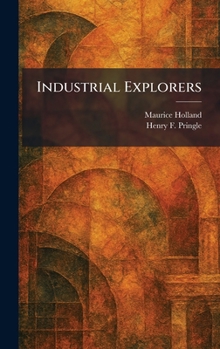
Industrial Explorers

Select Format
Select Condition 
Book Overview
"Industrial Explorers" offers a fascinating look into the lives and minds of the pioneers who bridged the gap between scientific discovery and industrial application during the early 20th century. Written by Maurice Holland and Henry F. Pringle, this collection of biographical profiles highlights the visionary leaders of America's most influential research laboratories. The work explores the transformation of the scientific method into a powerful engine for economic and technological growth.
The book features in-depth portraits of figures who shaped modern industry, including pioneers in fields such as chemistry, electronics, and engineering. By detailing their challenges, methodologies, and successes, "Industrial Explorers" illustrates the critical role that organized research plays in the evolution of society. It serves as both a historical record of a pivotal era in American development and a tribute to the individuals who viewed the laboratory as a frontier for exploration. Readers interested in the history of science, corporate innovation, and the biographies of great thinkers will find this volume an indispensable resource for understanding how the modern industrial landscape was forged through rigorous inquiry and inventive spirit.
This work has been selected by scholars as being culturally important, and is part of the knowledge base of civilization as we know it. This work was reproduced from the original artifact, and remains as true to the original work as possible. Therefore, you may see the original copyright references, library stamps (as most of these works have been housed in our most important libraries around the world), and other notations in the work.
This work is in the public domain in the United States of America, and possibly other nations. Within the United States, you may freely copy and distribute this work, as no entity (individual or corporate) has a copyright on the body of the work.
As a reproduction of a historical artifact, this work may contain missing or blurred pages, poor pictures, errant marks, etc. Scholars believe, and we concur, that this work is important enough to be preserved, reproduced, and made generally available to the public. We appreciate your support of the preservation process, and thank you for being an important part of keeping this knowledge alive and relevant.
Customer Reviews
ThriftBooks ® and the ThriftBooks ® logo are registered trademarks of Thrift Books Global, LLC
