


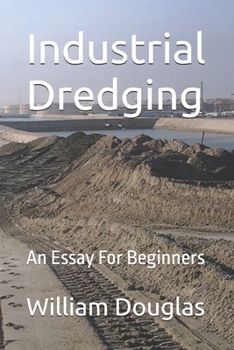
Industrial Dredging: An Essay For Beginners
No Customer Reviews

This book is primarily a detailed essay on the subject of industrial dredging practices. To produce this essay, I have coupled my personal experience of over 50 years in the maritime industry with materials found during my research process. Wherever possible I have provided credits to the sources of information which is not entirely from my own experiences.
I believe a useful way to introduce dredging to students is to emphasise its three coupled components. First is excavation or mobilisation, which describes how sediment is loosened and collected at the bed. Second is transport, which moves material away from the dredging area using barges, pipelines, or onboard hoppers. Third is placement and management, which includes confined disposal, sea disposal where permitted, dewatering and treatment, or beneficial use such as beach nourishment and habitat creation. In industrial settings, these three components must be designed as one integrated chain. For example, a hydraulic dredger may excavate continuously, but if the pipeline corridor is constrained or the placement site cannot accept slurry at the required rate, production will fall and operational risk will rise. Conversely, a mechanical dredger may excavate precisely, but if barge cycling time to the disposal site is long, the excavator or crane becomes underutilised. Reference credits are listed in the latter part of this document.
William Douglas........February 2026
I believe a useful way to introduce dredging to students is to emphasise its three coupled components. First is excavation or mobilisation, which describes how sediment is loosened and collected at the bed. Second is transport, which moves material away from the dredging area using barges, pipelines, or onboard hoppers. Third is placement and management, which includes confined disposal, sea disposal where permitted, dewatering and treatment, or beneficial use such as beach nourishment and habitat creation. In industrial settings, these three components must be designed as one integrated chain. For example, a hydraulic dredger may excavate continuously, but if the pipeline corridor is constrained or the placement site cannot accept slurry at the required rate, production will fall and operational risk will rise. Conversely, a mechanical dredger may excavate precisely, but if barge cycling time to the disposal site is long, the excavator or crane becomes underutilised. Reference credits are listed in the latter part of this document.
William Douglas........February 2026
Format:Paperback
Language:English
ISBN:B0GPHBR7LG
ISBN13:9798249127824
Release Date:February 2026
Publisher:Independently published
Length:54 Pages
Weight:0.20 lbs.
Dimensions:9.0" x 0.1" x 6.0"
Customer Reviews
0 rating
Copyright © 2026 Thriftbooks.com Terms of Use
| Privacy Policy | Do Not
Sell/Share My Personal Information | Cookie Policy | Cookie Preferences | Accessibility Statement
ThriftBooks® and the ThriftBooks® logo are registered trademarks of Thrift Books Global, LLC
ThriftBooks® and the ThriftBooks® logo are registered trademarks of Thrift Books Global, LLC
