


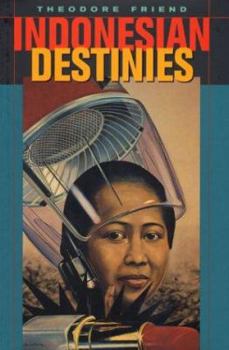
Indonesian Destinies

Select Format
Select Condition 
Book Overview
How can such a gentle people as we are be so murderous? a prominent Indonesian asks. That question - and the mysteries of the archipelago's vast contradictions - haunt Theodore Friend's work, a narrative of Indonesia during the second half of the 20th century, from the post-war revolution against Dutch imperialism to the unrest at the beginning of the 21st century. Part history, part meditation on a place and a past observed first-hand, this book penetrates events that gave birth to the world's fourth largest nation and assesses the continuing dangers that threaten to tear it apart.
Format:Hardcover
Language:English
ISBN:0674011376
ISBN13:9780674011373
Release Date:June 2003
Publisher:Belknap Press
Length:640 Pages
Weight:3.05 lbs.
Dimensions:10.0" x 1.5" x 6.0"
Customer Reviews
5 ratings
The Indonesian Kaleidescope
Published by Thriftbooks.com User , 20 years ago
Indonesia is a vast archipelago of 17,000 islands, 14,000 of which are inhabited, stretching from the Indian Ocean to the Pacific. Imagine an island chain as broad as the continental US. It is the world's most populous Muslim nation, and the fourth largest in the overall rankings. It is a nation of countless ethnic groups and one that has more than 350 spoken languages. Theodore Friend has written an equally monumental and multifaceted work that reflects the kaleidscopic richness of Indonesia. He interviews not only presidents and generals, but ordinary people as well - people living their lives in characteristic Indonesian fashion, with grace under pressure. Friend gives very scholarly analyses of political events, religious thought, and the ebbs and flows of the economy. At times one gets the impression that this is a traveloge complete with photographs (over 100); clearly Friend has a great love for his subject. The book roughly falls into three sections covering the last half century of Indonesian history: Sukarno (1945-65), Suharto (1965-98), and the Successors (Habibie,Whahid, and Sukarnoputri {1998-2002}). With the Cold War over, Friend is able to give us a more balanced look at the presidencies of Sukarno and Suharto. It is no longer sufficient to view the first as the bad guy and the second as the good guy. Minus the Cold War prism the realities are much more subtle. Sukarno, for his part, was up against an immense number of competing forces: a power hungry army, a Communist party, a restless Islamic movement, and the various ethnic and separatist groups that wanted more autonomy. Sukarno was a gifted orater. He was able, with the spell that he cast over his people, to shape a national ethos that spoke for many, if not all, of these competing groups. He was able to give Indonesians a sense of national identity and dignity that they never had under the Dutch and Japanese occupations. His downfall was controversial: some say it was corruption and economic mismanagement that caused it, others say it was a coup that was given the blessing, if not the outright support of the CIA and the Pentagon, since he was getting a little to cozy with the Communists. Friend judiciously gives all sides of the story and lets the reader decide. The 1965 coup that brought Suharto to power and kept him there for the next 30 plus years was, for better or for worse, a period of stability and development. Friend is of the school of thought that an authoritarian figure that sacrifices democratic progress to economic progress is tolerable as a transitional figure. Suharto, unlike Sukarno, understood basic things: namely, that people needed to eat, that they needed jobs, and that they needed education; and he was fairly successful in delivering these public goods. During his time in power, Indonesians had three decades of economic progress. Friend also describes the dark side of Suharto's rule that was conveniently overlooked during the Cold
Eye opening even for Indonesians
Published by Thriftbooks.com User , 22 years ago
This book is the most comprehensive and yet not-too-hard read on Indonesian independence history that I have found. With detailed accounts of important events, vivid descriptions, and personal experience, Theodore Friend is able to weave together a compelling story about the complexity of the Indonesian history since independence. The crucial facts and theories are insightful if not eye-opening, especially for Indonesians who have not been exposed to the nation's history from an outsider perspective.
A through study of events in Indonesia over the years
Published by Thriftbooks.com User , 22 years ago
Every single page in this book offers a glimpse into the complexity of Indonesian society. As a reader, we are brought into understanding the social events that occurred in this country through differing point of views, from the powerful government, the simple yet hopeful citizens or foreigners that either fell in love with the country or somehow managed to get themselves tied to the country. As an Indonesian myself, I am thankful to Mr.Friend for this book. It is like a glass of water quenching the thirst of knowledge on the subject that has too long been oppressed in Indonesia itself. More than anything, this book serves its purpose well that is to make readers, both Indonesian and those affiliated, to question many unfortunate social disorders that had befallen upon this country. If Indonesia is heading toward to a better society, only a study into her past will guides her future. By ignoring the mistakes from the past social disorders, Indonesia will only fall back to the same state many years to come in the future, only a matter of time. This book put out the many issues for readers to discuss, to ponder and to question. From reading the book, we know as a reader that this book is written by a writer that really cares about the issues in Indonesia.
a must for anyone interested in southeast asia
Published by Thriftbooks.com User , 22 years ago
This book is clearly a labor of immense scholarship--the author takes on the last fifty years of Indonesian history, and includes in his sweep a magisterial treatment of the country's religion, politics, and cultural layers--but it is, more importantly, a labor of love. Friend intermixes thoughtful and persuasive analysis with chapters about his own trips through the archipelago over the past thirty years. These, along with the many magnificent photographs and illustrations, give a real flavor of the place: its cultural richness and socioeconomic poverty. Truly worth the time it takes to read and ponder.
A Magisterial Work
Published by Thriftbooks.com User , 22 years ago
In a style that ranges from academic to personal, objective to emotional, Friend presents an incisive exploration of Indonesia: its history, its people and culture. It is a remarkable synthesis of historical description and theoretical explanation drawing on many primary sources and departments of knowledge: geography, economics, social theory.If you ever wanted to understand Indonesia holistically-not simply through the lens of economics or religion, this book should be on your list.
Copyright © 2026 Thriftbooks.com Terms of Use
| Privacy Policy | Do Not
Sell/Share My Personal Information | Cookie Policy | Cookie Preferences | Accessibility Statement
ThriftBooks® and the ThriftBooks® logo are registered trademarks of Thrift Books Global, LLC
ThriftBooks® and the ThriftBooks® logo are registered trademarks of Thrift Books Global, LLC
