


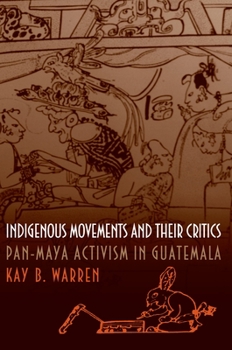
Indigenous Movements and Their Critics: Pan-Maya Activism in Guatemala

Select Format
Select Condition 
Book Overview
In this first book-length treatment of Maya intellectuals in national and community affairs in Guatemala, Kay Warren presents an ethnographic account of Pan-Maya cultural activism through the voices, writings, and actions of its participants. Challenging the belief that indigenous movements emerge as isolated, politically unified fronts, she shows that Pan-Mayanism reflects diverse local, national, and international influences. She explores the movement's attempts to interweave these varied strands into political programs to promote human and cultural rights for Guatemala's indigenous majority and also examines the movement's many domestic and foreign critics.
The book focuses on the years of Guatemala's peace process (1987--1996). After the previous ten years of national war and state repression, the Maya movement reemerged into public view to press for institutional reform in the schools and courts and for the officialization of a "multicultural, ethnically plural, and multilingual" national culture. In particular, Warren examines a group of well-known Mayanist antiracism activists--among them, Demetrio Cojt , Mart n Chacach, Enrique Sam Colop, Victor Montejo, members of Oxlajuuj Keej Maya' Ajtz'iib', and grassroots intellectuals in the community of San Andr s--to show what is at stake for them personally and how they have worked to promote the revitalization of Maya language and culture. Pan-Mayanism's critics question its tactics, see it as threatening their own achievements, or even as dangerously polarizing national society. This book highlights the crucial role that Mayanist intellectuals have come to play in charting paths to multicultural democracy in Guatemala and in creating a new parallel middle class.Format:Paperback
Language:English
ISBN:0691058822
ISBN13:9780691058825
Release Date:December 1998
Publisher:Princeton University Press
Length:336 Pages
Weight:1.10 lbs.
Dimensions:0.8" x 6.0" x 9.2"
Related Subjects
Ancient Ancient Civilizations Anthropology Central America Civil Rights Civil Rights & Liberties Comparative Politics Discrimination & Racism Education & Reference Government Guatemala History Latin America Legal Theory & Systems Mayan Minority Studies Native American Studies Non-US Legal Systems Political Science Politics & Government Politics & Social Sciences Race Relations Social Science Social Sciences Specific Demographics Specific TopicsCustomer Reviews
1 rating
Indigenous Movements
Published by Thriftbooks.com User , 25 years ago
As a graduate studuent who has conducted ethnographic fieldwork in Guatemala, I found this book to very insightful. In my view, Kay Warren does a commendable job of addressing and discussing the politics of the Pan-Maya movement and its actions and arguments since the signing of the peace accords. Furthermore, she describes the role of the foreign anthropologist in the Maya culture and the critiques given by Pan-Maya activists towards the discipline of anthropology. For example, Warren relates the statements of the well-known Pan-Mayanist, Sam Colop (82). Warren concludes that the underlying question is; "What are you doing in Guatemala to benefit the Maya people?" This is particularly relevant to any social scientist, let alone those working in Guatemala.Of particular interest is Warren's discussion on 'transforming selves'; the belief that certain individuals possess the capacity to physically transform themselves into an animal. She provides an excellent argument on why this belief resurfaced during the civil war, a period of extreme distrust. The bibliography is extensive and Warren's knowledge of critical theory, anthropology, history, Guatemalan (and, one might add, Peruvian) ethnography and political studies is considerable. This book could serve as a starting point for anyone interested in the current situation in Guatemala.The only shortcoming I found is that the chapters do not flow smoothly. This is most likely due to the fact that some of the book was derived from previously written articles.Nevertheless, I found it to be an enjoyable read and strongly recommend it to anyone interested in Guatemala and the Maya culture.
Copyright © 2026 Thriftbooks.com Terms of Use
| Privacy Policy | Do Not
Sell/Share My Personal Information | Cookie Policy | Cookie Preferences | Accessibility Statement
ThriftBooks® and the ThriftBooks® logo are registered trademarks of Thrift Books Global, LLC
ThriftBooks® and the ThriftBooks® logo are registered trademarks of Thrift Books Global, LLC
