


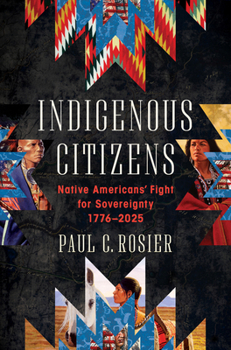
Indigenous Citizens: Native Americans' Fight for Sovereignty, 1776-2025

Only Native Americans have held the political identity of being citizens of nations within a nation. After the American Revolution, they had to decide whether gaining United States citizenship would help to preserve their rights and property or be used to take them away--and they found out that either decision could end in loss.
To understand the profound consequences of their choices, historian Paul C. Rosier creates a sweeping portrait of the broad history of Indigenous Americans. Indigenous Citizens is unique in its breadth, its focus on the evolution of Native Americans' dual citizenship, and its coverage of Indigenous issues from the founding of the United States through the twenty-first century.
This masterful work highlights Native people's efforts to preserve their tribal sovereignty and to secure the civil rights afforded to other Americans. In it, Rosier chronicles Native Americans' extraordinary resistance to colonialism, forced removals from ancestral homelands, and coercion into Indian Boarding Schools, even as the United States government broke treaty after treaty. He explores how Native people defended their right to be both Native and American. Native Americans differ religiously, culturally, and politically. But, as Rosier weaves together their experiences negotiating tribal, state, and national status, he reveals their vision for a country that could live up to the ideals of its Constitution. Through military service, activism, and political writings, Native people have long championed their belief in a United States of civil liberties and called on it to honor its legal obligations.
In Indigenous Citizens, Rosier demonstrates how their campaigns for justice have helped to expand, redefine, and strengthen democratic freedoms for all American citizens, even as the rights of their citizenship continue to be contested.
Related Subjects
HistoryCustomer Reviews
ThriftBooks® and the ThriftBooks® logo are registered trademarks of Thrift Books Global, LLC
