


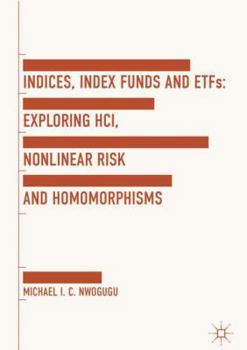
Indices, Index Funds and Etfs: Exploring Hci, Nonlinear Risk and Homomorphisms

Chapter 1. Introduction.
1.1. How this Book Differs from Other Books About ETFs, Indices and Index Funds.
1.2. Regulatory Failure, Regulatory Capture and Regulatory Fragmentation.
1.3. Some Mathematical Commonalities Among Debt, Equity and Commodity Indices.
1.4. The Chapters: Activity Theory and HCI.
1.5. Momentum Effects, Systemic Risk and Financial Instability.
1.6. The Usefulness of Alpha and Beta as Currently Construed; and the Debate About Active Management versus Passive Management.
1.7. ETFs vs. Mutual Funds vs. Closed-End Funds.
1.8. The Case-Shiller Real Estate Indices Are Very Inaccurate and Mis-leading.
1.9. Tax Aspects of Investing in ETFs and Indices.
1.10. Forecasting and Comparisons of Stock Indices and ETFs.
1.11. Network Analysis and Complexity in Stock Indices and ETFs.
Chapter 2. Decision-Making and Spatio-Temporal Cognitive Biases and Homomorphisms in Traditional Stock/Bond/Commodity Index Calculation Methods in Incomplete Markets with Partially Observable Un-Aggregated Preferences, MN-Transferable-Utilities and Regret-Minimization Regimes.
2.1. Existing Literature.
2.1.1. Traditional Indices As Options-Based Indices.
2.2. MN-Transferable-Utility.
Theorem-1.
2.3. The ICAPM/CAPM Are Inaccurate.
Theorem-2.
Theorem-3.
2.4. The Traditional Index Calculation Methods (applicable to many equity, debt, real estate, commodity and currency indices).
2.4.1 Market-Capitalization Weighted Indices (And "Diversity" Indices).
Theorem-4:
2.4.2. Free Float Adjusted Indices.
2.4.3. Fundamental Indices.
2.4.4. Stock-Price Weighted Indices.
2.4.5. Trading-Volume Weighted Indices.
2.4.6. Market-Cap Weighted and Volume-Weighted Indices (Two Methods).
2.4.7. Dividend-Weighted Indices.
2.4.8. Equal-Weight Indices.
2.4.9. Thomson Reuters's Indices.
2.5. Other Distortions in Traditional Indices.
Theorem-5
Theorem-6
Theorem-7
Theorem-8
Theorem-9
Theorem-10
2.6. Traditional Index Calculation Methods Create Significant Incentives for Companies to Perpetrate Earnings Management.
2.7. Conclusion.
Chapter 3. A Critique of Credit Default Swaps (CDS) Indices.
3.1. Existing Literature.
3.2. Quasi-Default Versus Reported Default: the Difference Reduces the Usefulness of CDS Indices.
3.3. The Credit-Ratings Lag.
3.4. The Methods for Pricing Of Debt Reduces the Accuracy of CDS Indices.3.5. Behavioral Effects and Externalities Inherent in the Use CDS, and Which May Distort the Accuracy of CDS-Indices.
3.6. Financial Stability.
3.7. S&P's Credit Default Swap (CDS) Indices - the S&P CDS Index Calculation Methods Are Wrong.
3.8. Conclusion.
Chapter 4. Invariants and Homomorphisms Implicit in, and the Irrelevance of the Mean-Variance Framework in Risk Analysis, Decision-Making and Portfolio Management
4.1. Existing Literature.
4.2. The Mean Variance Framework is Inaccurate
Theorem-2
Theorem 3
Corollary-#1
Corollary-#2
Corollary-#3
Corollary-#4
Corollary-#5
Corollary-#6
Corollary-#7
Corollary-#8
Corollary-#9
Corollary-#10
Corollary-#11
Corollary-#12
Corollary-#13
Corollary-#14
Corollary-#15
Chapter 5. Decision-Making, Su
Customer Reviews
ThriftBooks® and the ThriftBooks® logo are registered trademarks of Thrift Books Global, LLC
